The Financial Model Council: How CFOs Should Use AI to Catch Beautifully Wrong Models
AI can now build the model fast. That is not the hard part. The hard part is knowing whether the assumptions are commercially true.
A finance leader shared a useful example on LinkedIn: Claude built a five-year, three-statement model in roughly forty minutes. Income statement, balance sheet, cash flow, formatting, cross-references. The kind of work that used to take the better part of two days came back before the first coffee had gone cold.
Then came the important part.
The review took three hours.
The model was technically clean. The formulas worked. The structure held. The issue was not spreadsheet mechanics. The issue was revenue growth. The assumptions looked reasonable because they were anchored in real sector benchmarks. But they were wrong for that specific business, customer type, market, and conversion reality.
That is the part every CFO, founder, and investor should sit with for a minute.
The danger of AI-assisted finance work is not that it builds messy models. The more dangerous failure mode is that it builds polished models on top of weak assumptions.
A clean model can still be commercially wrong
Most of the conversation around AI and financial modeling is still stuck on the wrong question: Can AI build the model?
Increasingly, yes. It can create a structure. It can format tabs. It can draft a revenue build. It can connect the statements. It can summarize the outputs in investor-friendly language.
But that only answers the easiest part of the workflow.
The model can be clean and still be wrong. The formula can be right and the assumption can be false. The benchmark can be real and still not apply. The forecast can look conservative against a market average while being wildly optimistic for the actual sales motion of the business.
That is why the phrase "AI built the model in forty minutes" should not be the end of the story. It should be the beginning of the review.
The benchmark laundering problem
One of the more dangerous AI behaviors in finance is what I would call benchmark laundering.
The model finds a real number from a real source. The number is broadly associated with the sector. Then it quietly promotes that number into a company-specific assumption.
That jump is where models break.
A sector growth rate is not a sales forecast. A market benchmark is not a conversion rate. A public-company margin profile is not evidence that a founder-led business can scale delivery without adding headcount. A generic SaaS retention number does not tell you how sticky this specific product is for this specific customer segment.
AI is very good at finding plausible reference points. It is not automatically good at knowing whether those reference points belong in the model.
That is commercial judgment. And commercial judgment is not a formatting task.
The answer is not less AI. It is a better review architecture.
The lazy conclusion is: "See, AI cannot replace finance professionals."
True, but incomplete.
The better conclusion is that we are using AI in the wrong part of the workflow. We keep asking one AI system to act like a junior analyst that builds the model. The more useful pattern is to make AI act like a review council that attacks the model from multiple angles before a human signs off.
A financial model should not go from model builder to CFO review as one straight line. It should pass through a structured challenge process.
That process can be AI-assisted.
Not because AI has perfect judgment. It does not. But because different prompted review lenses can catch different classes of failure faster than one tired human doing the whole review manually.
What a Financial Model Council should review
A useful council is not a pile of generic agents with finance job titles. It is a set of specific review lenses.
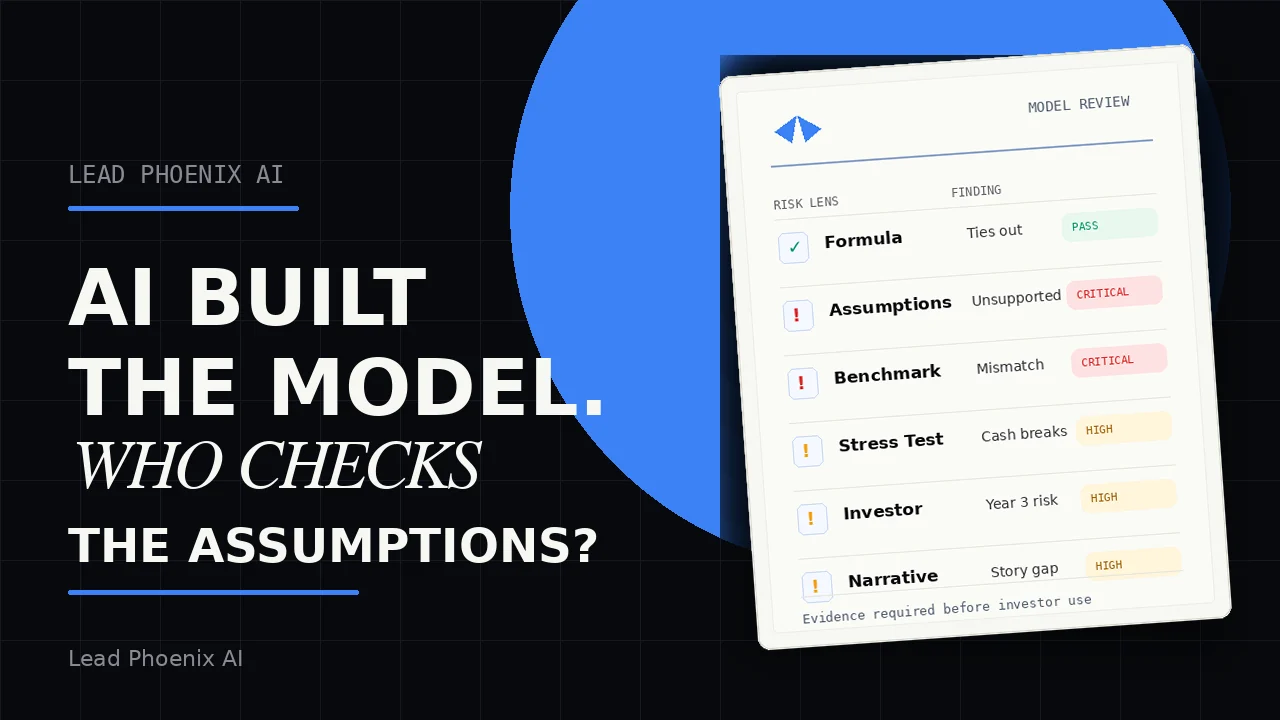
1. Formula auditor. This lens checks the mechanical model: broken links, inconsistent formulas, hardcoded cells, range errors, circular references, cash flow mismatches, and whether the balance sheet actually balances.
2. Assumption skeptic. This lens asks what would need to be true for the forecast to happen. It challenges revenue growth, conversion rates, churn, pricing, sales capacity, headcount, hiring timing, gross margin, and working capital assumptions.
3. Business model interpreter. This lens checks whether the model matches the way the business actually makes money. A services firm, SaaS company, marketplace, construction business, and CPA firm do not scale the same way. The model should not pretend they do.
4. Market reality checker. This lens evaluates whether benchmarks and comparables are actually comparable. It flags when the model has imported a market average without proving relevance to the company’s niche, customer segment, geography, or channel.
5. Investor committee reviewer. This lens asks what a sophisticated investor, lender, or board member would challenge first. Which assumption drives the story? Which number would get haircut immediately? Which slide creates the most false confidence?
6. Scenario stress tester. This lens tests what happens if growth is slower, churn is higher, sales cycles are longer, hiring is delayed, gross margin compresses, or working capital tightens.
7. Narrative consistency reviewer. This lens compares the model to the story. If the memo says enterprise sales but the model assumes SMB conversion speed, that is a red flag. If the pitch says conservative forecast but year-three growth quietly accelerates, that is a red flag.
Each lens produces a different kind of objection. The CFO or finance lead still makes the call. The council’s job is to make the weak spots visible before the model reaches an investor, lender, or board.
The council does not validate the model. It finds where the model is fragile.
This distinction matters.
I would not describe this workflow as "AI validates your financial model." That is too strong. It creates a false sense of assurance, which is the exact problem we are trying to avoid.
A better promise is:
A structured AI review council pressure-tests the model for hidden assumption risk before it reaches a high-stakes audience.
That is more honest. It is also more useful.
The output should not be a green checkmark. It should be a ranked list of concerns:
- Critical: assumptions that materially change valuation, liquidity, covenant headroom, or the funding story.
- High: assumptions that need evidence before external use.
- Medium: assumptions that need explanation or sensitivity analysis.
- Low: clarity, formatting, labeling, or secondary issues.
The council should also name the evidence required before the model is shared: actual funnel data, historical cohort retention, customer-level revenue concentration, sales cycle data, delivery capacity, pricing history, and prior forecast misses.
That is the difference between a model that looks finished and a model that has been challenged.
Without business context, the council will still miss things
There is a hard truth here.
A financial model council is only as good as the context it can inspect.
If you give it only a spreadsheet and a two-paragraph company description, it can find formula issues, obvious assumption gaps, and generic investor questions. That is useful, but limited.
To catch the kind of issue in the LinkedIn example, it needs business evidence:
- historical revenue by product, segment, and customer type
- pipeline and conversion data
- sales cycle length by channel
- pricing and discount history
- churn, retention, and expansion data
- delivery capacity and hiring constraints
- customer concentration
- actuals vs forecast from prior periods
- management notes explaining what changed in the business
Without that context, the council can say "this assumption is risky." With that context, it can say "this assumption is not supported by how this business actually sells."
That is a much more valuable sentence.
The CFO pattern: human authorship, AI challenge, human approval
The safest pattern is not "AI builds, human glances."
It is:
- The finance team owns the model and the assumptions.
- The AI council reviews the model from multiple lenses.
- The council produces red flags, evidence gaps, and sensitivity recommendations.
- The CFO or finance lead decides what to change.
- The final model keeps an audit trail of what was challenged and what was approved.
That keeps the human in the seat where judgment matters. It also gives the human a better review surface.
In finance, speed without challenge is dangerous. But challenge without speed is expensive. The council pattern gives you both: faster first drafts and stronger second-order review.
The bigger point
The future of AI in finance is not just faster models. It is better review gates.
That is less flashy than a demo where a model appears in forty minutes. But it is closer to where the value is.
For a CFO, investor, or founder, the most expensive mistake is not a spreadsheet that is obviously broken. That gets caught.
The expensive mistake is the model that looks finished, reads well, ties out, and quietly tells the wrong story about the business.
That is the model a Financial Model Council is built to catch.
AI should not just help finance teams produce work faster. It should help them argue with the work before the board, lender, or investor does.
Where to start
If you want to build this in a finance team, do not start with seven agents and a grand platform.
Start with one model review. Pick a forecast, fundraising model, board model, covenant model, or budget scenario. Run a structured challenge across formulas, assumptions, market comparables, investor objections, scenarios, and narrative consistency. Then compare the council’s findings against what your CFO or finance lead already worries about.
If the council finds nothing useful, you learned cheaply.
If it finds the assumption everyone was quietly hoping not to discuss, you found the real use case.