85% of Companies Want AI Agents. 21% Are Ready.
Deloitte surveyed 3,235 leaders across 24 countries. The headline number is 85% planning to deploy AI agents. The number that actually matters is 37% — and it tells a different story.
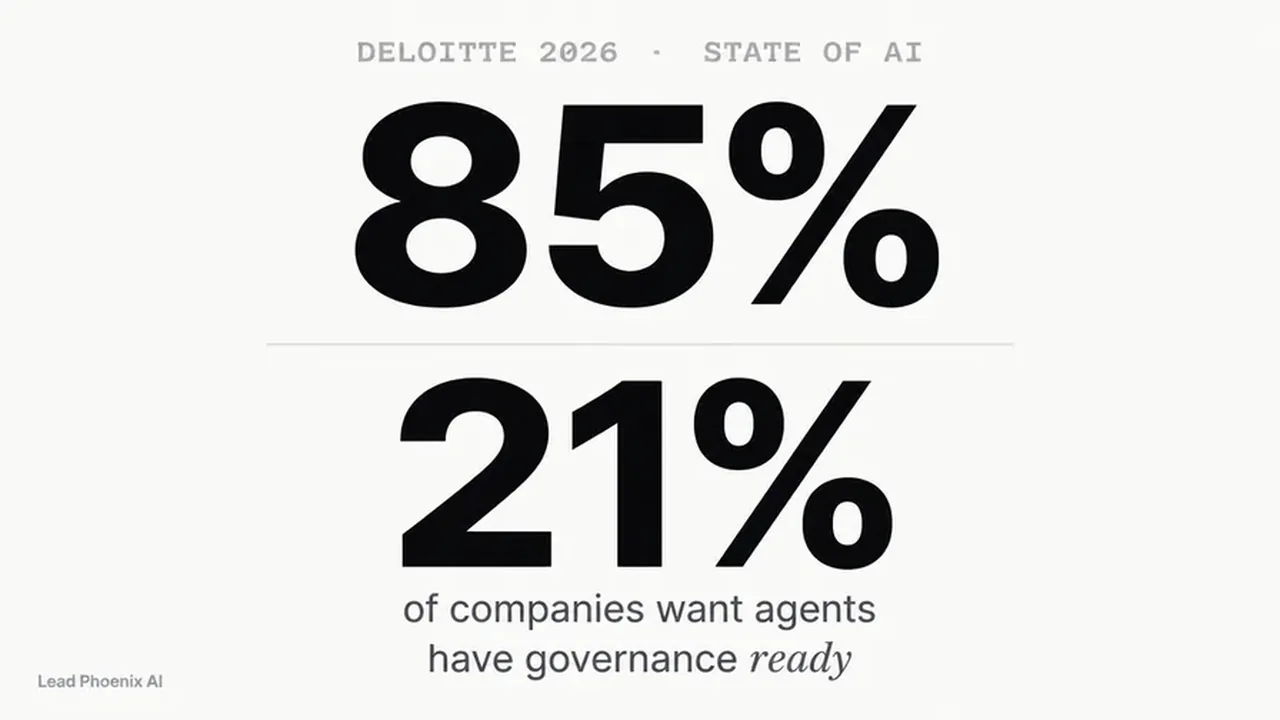
85% of companies plan to deploy AI agents. One in five has a governance model ready for them.
Deloitte's 2026 State of AI report covered 3,235 business and IT leaders across 24 countries. That 85%/21% split is the sharpest data point in it. It barely made the headlines.
Here is what it means.
The number that matters more than 85%
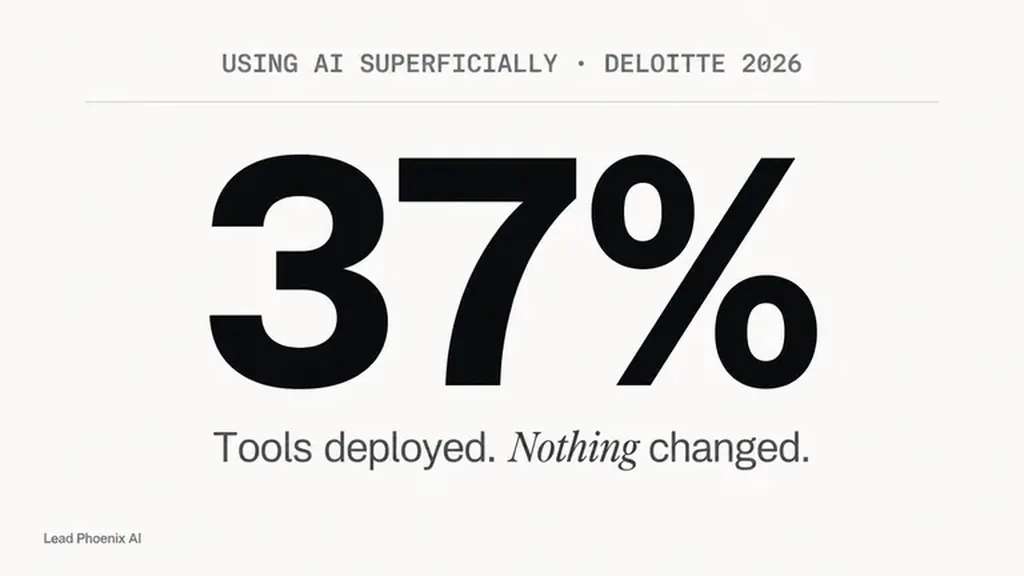
Most coverage focused on the ambition. The number I keep coming back to is 37%.
That is the share of organizations using AI with minimal changes to how they actually operate. Tools deployed. Licenses paid. Pilots ran. And nothing changed.
This is the pattern I see in almost every mid-market firm I talk to. Someone buys ChatGPT for the team. Maybe they run a pilot. The pilot works well enough. And then it just sits there.
I call it the ChatGPT-license trap. You have the tool. You do not have the ownership, the data infrastructure, or the accountability that would make it do something durable.
Why agents are a different problem
An AI agent is not a chatbot. A chatbot waits to be asked.
An agent runs a process — on its own schedule, against your data, producing outputs that feed into real decisions inside your business. That is a fundamentally different thing.
Which means what it runs on matters enormously.
If your data is scattered across a project management tool that does not talk to your finance system, which does not talk to your CRM, which does not talk to your client communication history — the agent is not seeing your business. It is seeing a fragment. And it will produce outputs based on that fragment. Fast. Consistently. In volume.
That is the actual risk in the 85%/21% gap. Most companies rushing toward agents have not built the data foundation that agents need to produce reliable outputs.
The step most firms skip
Only 25% of companies have moved 40% or more of their AI pilots into production. The question is why — because the technology is not the issue. The pilots worked. The company was not structurally ready to run AI in production.
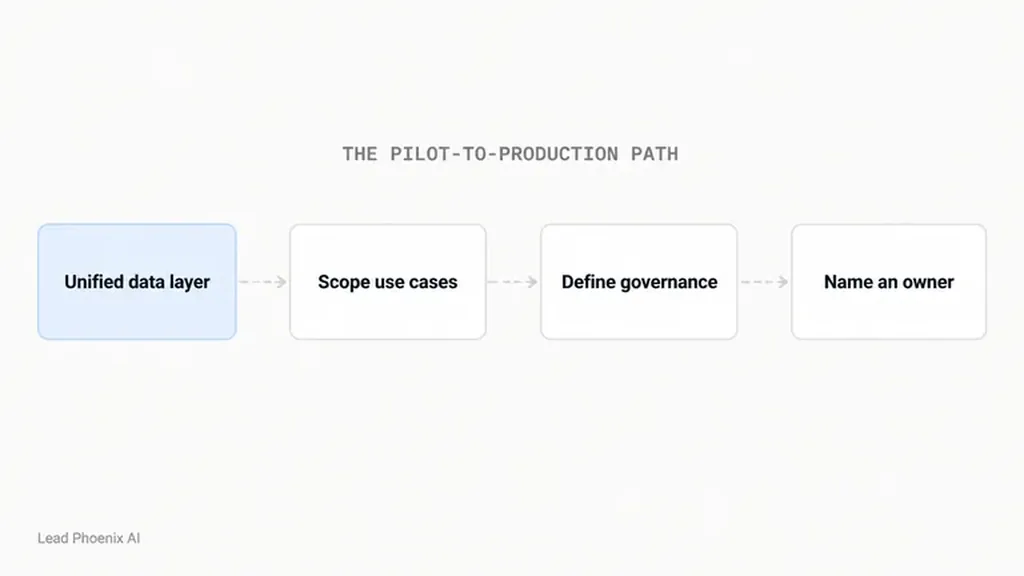
Running AI in production needs four things:
- A unified data layer the agents can trust
- Defined boundaries — what the agent can do autonomously, what requires human sign-off
- Someone accountable for AI performance, data quality, and when things go wrong
- A feedback loop so the system improves over time
None of those are technology decisions. They are leadership and operational decisions.
The 25% with real production deployments built this foundation first. The 37% using AI superficially skipped it.
What this means if you run a mid-market firm
Deloitte's survey covers enterprise-scale organizations. The pattern is identical at $50M.
A $50M CPA firm, a $100M construction company, a 150-attorney law firm — all have the same fragmentation problem. Project data in one tool. Finance in another. Client communication somewhere else. Decisions in people's heads.
When you ask "which clients are most at risk based on delivery delays and open issues?" — most firms cannot answer it. Not because the answer does not exist. Because the data to produce it lives in three systems that have never been connected.
Deploy an agent on top of that, and you are not getting smarter. You are making the fragmentation run faster.

The sequence that works, at every scale:
- Connect the data first. One source of truth that all your operating systems feed into.
- Scope two or three specific use cases where agents can produce measurable impact.
- Define governance — what gets human approval, what runs automatically.
- Name an owner. One person accountable for AI strategy, data quality, and production performance.
That is the gap between the 25% with production AI and the 75% still running pilots.
The question worth sitting with
The most important finding in the Deloitte report is not the 85% rushing toward agents.
It is the 37% who have been "doing AI" for months or years, and whose business still operates the same way it did before.
If that is your firm: the question is not which tool to add next. It is — who owns the data layer, who owns the governance, and who is accountable for getting pilots into production?
If the answer is nobody, that is what needs to change first.
Temi Abayomi is the CEO of LeadPhoenix AI and a fractional Chief AI Officer for mid-market professional services and project-based businesses. The AI Readiness Audit is a good starting point if you want to know where your firm actually sits.