Your AI Governance Plan Is Not Late. It Never Started.
Most mid-market firms treat AI governance as a future-phase activity — something to plan once the pilots are proven. IBM's 2025 breach data says the exposure is already there. Here's what's actually running in your building right now, and the three questions that reveal it.
Uber deployed Claude Code to roughly 5,000 engineers in December 2025. Usage nearly doubled by February 2026. By April — four months into the year — the company had burned through its entire 2026 AI budget. No breach. No scandal. Just a complete loss of financial control over a tool that had been formally approved, by one of the most technically sophisticated companies on earth, with a full engineering organisation watching.
If that can happen at Uber, the question for a mid-market CFO or managing partner isn't "could this happen to us?" It's "how would we even know if it already had?"
That's the myth I want to dismantle here. The myth that AI governance is something you plan for as you scale, a phase-three activity you get to once the pilots are proven and the board is bought in. The consulting firms sell it that way. The enterprise AI vendors frame it that way. And it's wrong.
The exposure isn't coming. It's already there.
The Myth: Governance Is a Planning Exercise
Here's how the prevailing wisdom frames it: deploy first, prove value, then build governance around what's working. It sounds reasonable. It's how most technology rollouts have worked for the last twenty years.
The problem is that AI tools don't wait for your governance program to catch up. Your team is already using them.
IBM's 2025 Cost of a Data Breach report, which covered 3,470 interviews across 600 organisations, found that 1 in 5 organisations had a breach directly tied to shadow AI. Those breaches cost $4.63 million on average, which is $670,000 more than the global average. And 63% of the organisations that experienced AI-related breaches had no governance policy in place or were still developing one at the time.
That's not a future risk. That's the current state of most mid-market companies running any AI program at all.
What's Actually Running in Your Building
Here's what shadow AI looks like in practice at a 100-person professional services firm.
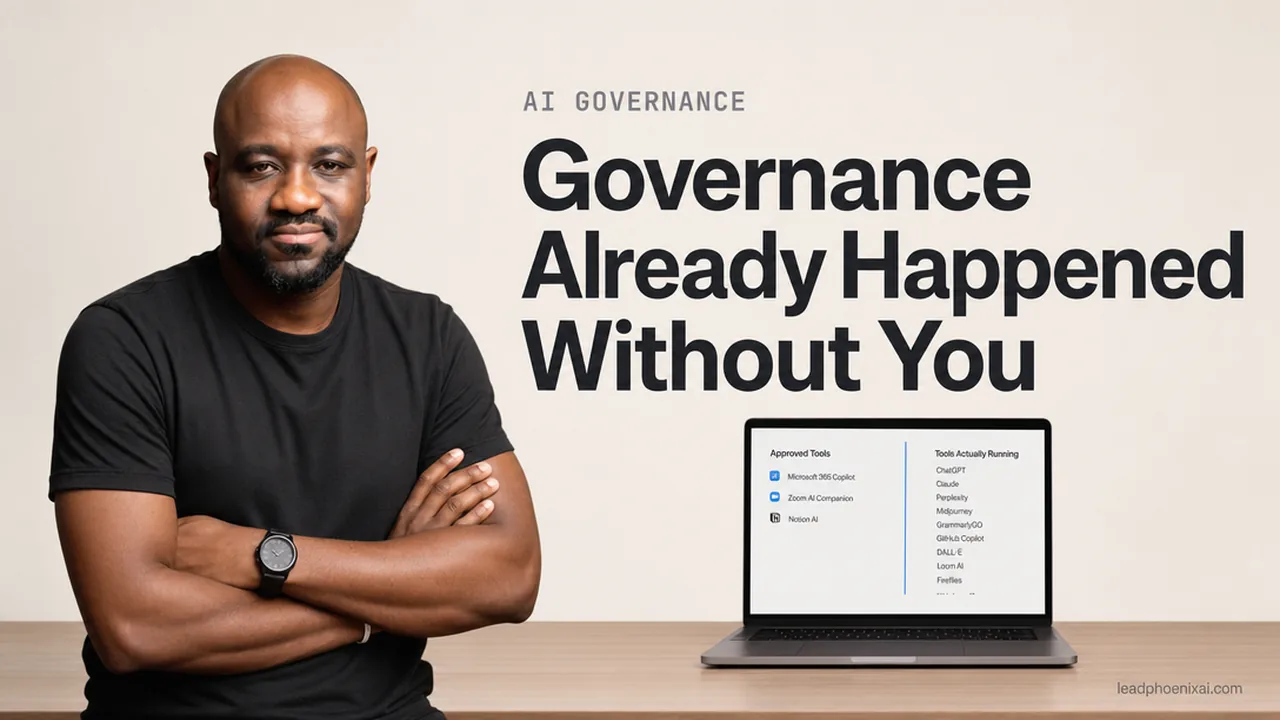
Your senior associate is using a personal ChatGPT account to draft client memos. Your operations manager has connected Grammarly to the firm's email, and Grammarly now has an AI layer that processes every message it touches. Your BD lead is using an unapproved AI research tool to pull prospect intelligence. Your finance team is pasting budget data into a free AI summariser to prep for the partner meeting.
None of these people think they're doing anything wrong. They're trying to do their jobs faster. And none of this shows up anywhere in your approved-tools list.
Netskope's 2026 research found that nearly 47% of generative AI users access tools through personal accounts, completely bypassing enterprise controls. Reco AI's data found that 82% of employees pasting data into AI prompts are doing it from unmanaged accounts. At smaller companies, Reco found up to 269 unsanctioned AI tools per 1,000 employees, a figure that's directionally consistent with what I see when we do our first governance audit inside a mid-market firm.
There's also a category most people miss entirely: AI that's embedded in tools you've already approved. Zoom, Salesforce, Adobe, and Grammarly all have AI features that may be processing company data right now, without anyone having explicitly decided that was acceptable. That's not shadow AI in the traditional sense. It's passive exposure through approved software.
The Three Questions That Reveal Your Current Exposure
You don't need a full governance program to understand where you stand today. You need honest answers to three questions.
One: What AI tools are already in the building, paid for or not?
This means approved tools, personal-account tools your team is using on company work, and AI features embedded in your existing SaaS stack. Most firms can answer the first category. Almost none can answer the second and third.
Two: What data do those tools have access to?
Not what data you intended them to have access to. What data they actually touch. A personal ChatGPT account used to draft a client deliverable has access to whatever the employee pastes into it. That's client data leaving your building through a channel you didn't approve and can't audit.
Three: Who approved that access?
If the answer is "nobody" or "I'm not sure," you don't have a governance problem coming. You already have one.
Deloitte's research found that while 33% of executives claim comprehensive AI usage tracking, only 9% have working governance systems. Gartner's Q2 2025 survey of IT leaders found that only 23% were very confident in their organisation's ability to manage security and governance when deploying AI tools. The gap between what leaders think is happening and what's actually happening is where the exposure lives.
Why the Skip-Governance-for-Speed Trade-Off Is False
I hear this reasoning a lot: "We need to move fast. Governance will slow us down. We'll get to it once we've proven the value."
It sounds pragmatic. It isn't.
By the time something breaks, the data has been moving for months. The liability is already established. IBM's data found that 97% of organisations that reported AI-related breaches lacked proper access controls at the time of the breach. They weren't ungoverned because they were reckless. They were ungoverned because they were moving fast and planned to get to governance later.
An ungoverned breach isn't a compliance footnote. It's a board conversation, a client notification, potentially a regulatory event. The speed you gained by skipping governance doesn't survive contact with that outcome.
And the financial exposure isn't limited to breaches. The Uber story is a governance failure that was purely financial — no breach, no data loss, just a complete loss of cost control over an approved tool. Goldman Sachs projects 24x token consumption growth between 2026 and 2030. If you don't have instrumentation on what your team is running and what it costs, you don't have an AI strategy. You have an open tab.
What a Governance Audit Actually Looks Like
I'm not talking about a six-month compliance program. I'm talking about a two-to-three week audit that answers the three questions above and produces three things.
An approved-tools registry. Every AI tool in the building, categorised by approval status, data access level, and who owns the relationship. This is the baseline you need before you can write any policy, because you can't govern what you haven't inventoried. ISACA's practitioner framework is clear on this: discovery and classification have to come before policy.
A data classification map. Which data categories are in play, which tools have access to them, and where the highest-risk intersections are. Client data, financial data, and personnel data each need a clear answer on what can touch them and under what conditions.
A human-approval seam design. For any AI workflow that touches sensitive data or produces outputs that affect clients, there needs to be a visible point where a human reviews and approves before anything goes out. This isn't about distrust of the technology. It's about accountability. If something goes wrong, you need to be able to show exactly where a human signed off.
None of this is glamorous. It doesn't look like transformation from the outside. But it's the foundation that every other AI initiative runs on. Without it, you're deploying agents on top of an exposure you haven't mapped, and the first thing that goes wrong will cost you far more than the audit would have.
The Honest Framing
Most AI governance conversations are framed as forward planning. "How do we govern this as we scale?" That's the wrong question.
The right question is: what is already running in your building that you didn't approve?
The answer to that question is the starting point. Not a roadmap. Not a phase-three initiative. The starting point.
If you're a managing partner or CFO at a mid-market firm and you can't answer the three questions above today, you don't have a governance problem coming. You already have one. The only question is whether you find out on your terms or after something breaks.
Frequently Asked Questions
What exactly is shadow AI, and how is it different from approved AI tools?
Shadow AI refers to any AI tool being used inside your organisation that hasn't been formally reviewed and approved — including personal ChatGPT or Claude accounts employees use on company work, unapproved browser extensions, and AI features embedded in SaaS tools you've approved for other purposes. The distinction matters because shadow AI tools process company data through channels you can't audit, can't control, and may not even know about. Approved tools have at least been reviewed; shadow AI tools have not.
How much does a shadow AI breach actually cost compared to a standard breach?
IBM's 2025 Cost of a Data Breach report found that breaches involving shadow AI cost $4.63 million on average — $670,000 more than the global average of $4.44 million. The cost premium comes from delayed detection and the difficulty of containing a breach that originated in an unmonitored channel. The IBM data covers 600 organisations and 3,470 interviews, so it's the most robust benchmark available, though the sample skews toward larger enterprises.
Do I need to ban AI tools to fix the governance gap?
Banning tools rarely works — Netskope's research found that nearly half of employees continue using personal AI accounts even after a ban. The more effective approach is to audit what's in the building first, then build a clear approved-tools registry with defined data access levels. For tools that receive failing security grades — no encryption, no multi-factor authentication — immediate blocking while governance is being built is defensible. But the goal is visibility and control, not prohibition.
What's the minimum viable governance audit for a 50-to-200 person professional services firm?
A realistic minimum covers three things: an inventory of every AI tool in the building (approved and unapproved), a data classification map that identifies which tools have access to client, financial, or personnel data, and a human-approval seam for any AI workflow that produces client-facing outputs. This can be completed in two to three weeks with the right outside perspective. It doesn't require a full compliance program — it requires honest answers to the three diagnostic questions and a documented baseline you can build policy on top of.
How does AI governance connect to the source-of-truth layer LeadPhoenix builds?
The governance audit and the source-of-truth layer are sequential, not parallel. The audit tells you what data exists, where it lives, who has access to it, and what tools are touching it. The source-of-truth layer connects those data sources into a unified architecture that every AI workflow pulls from. You can't build a reliable source-of-truth layer without first knowing what you're connecting — which is exactly what the governance audit surfaces. Governance first, then architecture, then agents.
Sources
Cited inline above:
- IBM / Ponemon Institute — Cost of a Data Breach Report 2025
- Netskope — Generative AI Data Exposure Report 2026
- Goldman Sachs — AI Infrastructure and Token Consumption Projections 2026–2030
Additional sources consulted for this piece:
- Reco AI — 2025 State of Shadow AI Report
- Deloitte — AI Governance Maturity Survey 2025
- Gartner — IT Leader Survey on GenAI Security and Governance, Q2 2025
- ISACA — Shadow AI Governance Practitioner Framework
- Cloud Security Alliance — Five-Step AI Governance Framework
- FTI Consulting — AI Governance Outlook 2026
- Eide Bailly — Middle Market AI Implementation Challenges