The Query Your CPA Firm Has Never Been Able to Ask
Most CPA firms have the data to answer their most important billing questions. It's sitting in three disconnected systems. Here's what changes when you connect them.
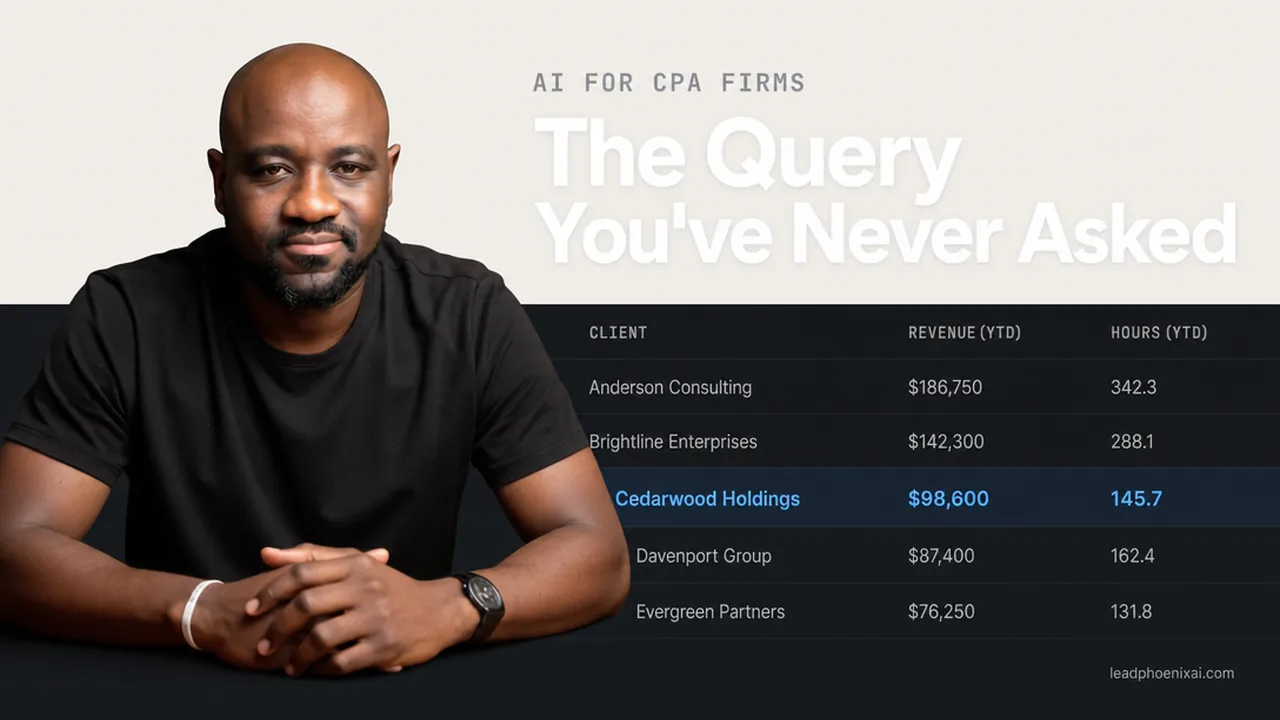
A managing partner at a mid-size CPA firm asked me once what the most valuable thing we could do for her practice was.
I told her I'd show her instead.
We connected her billing data in Karbon, her time entries in CCH Axcess, and her client revenue in QuickBooks Online into one unified layer. Then I typed a plain-English question: Show me every client where revenue grew but our hours dropped.
The system returned a ranked list in under ten seconds.
She stared at it for a moment. Then she said: "Why didn't we know this before?"
The answer is simple. The data existed in three separate systems for years. Nobody had ever connected them.
What the Workflow Actually Looks Like Today
This is the current state at most mid-size CPA firms, and I mean that literally, not as a rhetorical device.
Billing data lives in your practice management tool. Time entries live in your tax or workflow software. Client revenue lives in your accounting system. Your managing partner wants to understand which clients are generating the most value relative to the hours you're putting in. So the controller runs a manual Excel pull. It takes half a day. It's already out of date by the time it lands in the partner meeting.
The question "which clients are we under-billing relative to the value we're delivering" has never been formally asked at most firms. Not because nobody cares. Because the data to answer it doesn't exist in one place.
Partners make pricing decisions on gut feel and prior-year rates. They know something feels off with certain clients. They just can't prove it.
Wolters Kluwer's 2025 Future Ready Accountant Report puts it plainly: "AI is only as strong as the information it can access. If your invoices are buried in one system, contracts scattered in another, and project data siloed elsewhere, AI can't give you accurate insights."
That's not a technology problem. That's an architecture problem.
The Data Quality Problem Underneath the Query Problem
Before we even get to the query, there's something worth naming.
Most firms have 15 to 25% revenue leakage from inefficient time tracking, according to benchmarks from Makosi and WIN Lab. The median CPA firm utilization rate sits around 59.6%. Top performers hit 75 to 85%.
What that means in practice: the data feeding any cross-silo query is itself unreliable at most firms before you establish a source-of-truth layer. You can't run a meaningful "hours dropped" query if 15 to 25% of hours were never tracked in the first place.
This is why the source-of-truth layer comes before any automation or agentic work. Not because it's more interesting. It isn't. It's unglamorous infrastructure work. But it's the foundation everything else runs on. If you skip it and go straight to building agents, you're automating on top of broken data, and the outputs will be unreliable or, worse, confidently wrong.
Two in three accountants say they feel overwhelmed at least weekly by the volume and complexity of their tech stacks, according to an Accountex survey. The integration problem is not solved at most firms, even ones that have invested in it.
What Changes When You Connect the Systems
Here's the new shape of the workflow once the source-of-truth layer exists.
The managing partner opens a dashboard or types a plain-English question. The agent translates that into a SQL query. The database computes the answer. The model narrates the result, with every figure traced back to the source row, file, or system it came from.
This matters more than it sounds. I've seen finance agents fail in exactly one way, repeatedly: the model does the arithmetic itself instead of handing it to the database. Ask the same question twice and you get two different answers. Ask a follow-up and the model "corrects" to a more confident but more wrong number. For a managing partner presenting to clients or reviewing partner compensation, that's not a minor inconvenience. It's a trust-destroying failure.
The rule is non-negotiable: the LLM translates language into a query. The data layer computes the answer. Every number in the output comes from a tool call or a SQL result, never from the model's own math.
When that architecture is right, the results are concrete. One firm found that a 1% point increase in utilization translated to $250,000 in additional fees — work they were already doing but not capturing. Their managing partner described it this way: "At a glance, we're able to see who our biggest clients are as well as their increase or decrease in work year over year. We can rank clients by revenue change with a simple click."
That's not a technology demo. That's a business decision that was previously impossible.
The Query Forces a Harder Conversation
Most vendors won't tell you this part.
The "revenue grew, hours dropped" query doesn't just surface under-billing. It forces a reckoning with the billable hour model itself.
If your hours drop because AI made your team more efficient, and you're still billing by the hour, your revenue drops proportionally. The query that was supposed to find hidden value instead surfaces a structural problem: you're getting more efficient and getting paid less for it.
Bloomberg Tax reported in March 2026 that AI efficiency gains "create a tension" for firms still using hourly pricing — it lets people focus on higher-value work, but it strains the billing model. Michelle River, CEO of Fore LLC, said it directly: "Today's licensed accountants have been taught by their predecessors that they sell time. AI exposes the flaws of that approach. If firms don't adopt a more worth-based approach, they will have to add more clients to fill that void — and that's not sustainable."
Subscription billing has grown four-fold in the past year according to Thomson Reuters, but it still remains significantly underutilized. Most firms running this query for the first time will find it exposes a problem they're not yet structurally ready to solve.
That's not a reason to avoid the query. It's a reason to run it sooner, while you still have time to reprice proactively rather than reactively.
Kelly Fisher, Chief Practice Officer at Wipfli Advisory, put it well: "There's likely to be a conflict at a firm level if workers are encouraged to embrace technology yet their performance is evaluated based on the exact same metrics that we did a decade ago."
The query surfaces that conflict. What you do with it is a leadership decision, not a technology decision.
How to Roll This Out
You don't need to boil the ocean. Here's the sequence that works.
First, map where your data actually lives. Billing, time entries, and client revenue: which systems hold them, who owns them, and how they're accessed today. This is the audit step, and it usually takes a week of honest conversations with your controller and your ops lead.
Second, build the source-of-truth layer before you build anything else. Connect the systems. Establish clean data flows. This is not glamorous. It will not look like transformation from the outside. But it is the work that makes everything else possible. Wolters Kluwer's research is clear: "The closer firms get to a single source of truth — with consistent data models — the more reliable and explainable AI outputs become."
Third, pick one query. Not ten. One. The "revenue grew, hours dropped" query is a good starting point because it's specific, it's measurable, and it produces a list the managing partner can act on in the same week.
Fourth, make sure the architecture is right before you trust the output. The agent writes the SQL. The database computes. The model narrates with citations. If you can't trace every number back to a source row, the output isn't ready for a partner meeting.
Fifth, decide what you're going to do with what you find. The query is only valuable if it changes a decision. Which clients are you going to reprice? Which relationships are you going to have a different conversation with? The data gives you the list. The leadership conversation is yours to have.
87% of accounting professionals with highly integrated technology reported revenue growth in 2025, according to Wolters Kluwer. That's a correlation, not a guarantee — better-managed firms may self-select into higher integration investment. But the direction is clear. Firms that can ask questions across their data make better decisions than firms that can't.
Frequently Asked Questions
What systems need to be connected to run the "revenue grew, hours dropped" query at a typical CPA firm?
At most mid-size CPA firms, you're connecting three core systems: your practice management tool (Karbon or Canopy), your tax and workflow software (CCH Axcess or Thomson Reuters), and your accounting system (QuickBooks Online or Sage Intacct). The source-of-truth layer pulls data from all three into a unified layer that the query engine can read across. Without that connection, the data to answer the question exists — it's just in three places that have never talked to each other.
Why can't we just export everything to Excel and run the analysis there?
You can, and most firms do. The problem is it takes a controller half a day, it's already out of date by the time it lands in the partner meeting, and it can't be run on demand when a partner has a question mid-week. The source-of-truth layer makes the query available in real time, repeatable, and traceable — so the managing partner can ask a follow-up question and get an answer in seconds rather than scheduling another Excel pull.
What does the "revenue grew, hours dropped" query actually tell you?
It surfaces clients where your firm is delivering more value than you're billing for — either because your team got more efficient, because the scope of work expanded without a pricing conversation, or because you've been under-billing relative to market rates for years. The first run almost always surfaces a list that surprises the managing partner. It's not that the information was hidden — it's that nobody had ever connected the data to ask the question before.
What's the risk of running this query if our time-tracking data is unreliable?
It's a real risk. Most CPA firms have 15 to 25% revenue leakage from inefficient time tracking, which means the "hours" side of the query may be understated. The right response isn't to avoid the query — it's to treat the first run as directional rather than definitive, and to use the findings to start a conversation about time-tracking discipline at the same time as the repricing conversation. The query is still valuable even with imperfect data; you just need to be honest about the confidence level of the output.
Does this require replacing our existing systems?
No. The source-of-truth layer reads from your existing systems — it doesn't replace them. Karbon stays Karbon. CCH Axcess stays CCH Axcess. QuickBooks Online stays QuickBooks Online. What changes is that a unified layer sits on top of all of them, so queries can cross system boundaries for the first time. Your systems of record stay exactly where they are.
Sources
Cited inline above:
- Abdo Solutions — CPA Firm Utilization and Analytics Case Study
- Wolters Kluwer — Future Ready Accountant Report 2025
- Accountex — Professional Services AI and Tech Stack Survey 2025/2026
- Bloomberg Tax — AI Efficiency and Hourly Billing Tension, March 2026
Additional sources consulted for this piece:
- Makosi / WIN Lab — CPA Firm Benchmarks: Utilization, Revenue Leakage, and Profitability
- Thomson Reuters Institute — Tax Firm Pricing Report 2025
- Wipfli Advisory — Kelly Fisher on AI Adoption and Performance Metrics
- Fore LLC — Michelle River on Billable Hour Model and AI
- WIN Lab — Industry Benchmarks: Median Utilization and Untapped Profit Potential