Your AI Mandate Isn't Failing Because of the Model
Most companies blame the model when their AI mandate stalls. The real problem is almost never the model. It's that the data the agent needs to do anything useful is locked behind tools, silos, and access gaps nobody owns. Here's what's actually breaking enterprise AI — and the middle path that gets you moving this quarter.
The Myth: You Need a Better Model
A finance manager at a Fortune 50 company posted on r/CFO recently. His team has Microsoft Copilot. They have an internal ChatGPT-5 tool. They have a board-level AI mandate and a team actively training on SQL and pandas.
And the AI is still going nowhere.
His words: "with anemic access to the wide dataset, leveraging AI is cut off at the knees."
The finance data lives in a lake with no API endpoints. It's accessible only through Spotfire web-view tools with near-zero cross-domain visibility. The model is fine. The access layer is broken. The team is now waiting for APIs that may never come.
This is the dominant failure mode in enterprise AI right now. The breaking point is the data, not the model or the prompts or the vendor.
And yet the prevailing advice from vendors, IT, and LinkedIn is still to get a better tool.
Why That Advice Makes the Problem Worse
When your AI mandate stalls, the instinct is to upgrade. You shop for a better model or consider switching platforms. It feels like progress because it's a decision you can make in a meeting.
But if the data the agent needs is locked behind disconnected tools, gated by access controls nobody owns, or siloed across systems that have never talked to each other — a better model just fails faster. You've added cost and complexity without touching the actual constraint.
MIT's Project NANDA studied over 300 AI initiatives and found that 95% saw zero measurable return from generative AI. The researchers were direct about why: "The failure is almost never the model. It is data readiness, workflow integration, and the absence of a defined outcome before build starts."
A separate analysis of 140 enterprise AI implementations found that only 23% of failures were caused by model performance or integration complexity. The remaining 77% came down to strategy, governance, and change management.
Not the model. The operating model.
What's Actually Breaking Your AI Mandate
In almost every mid-market engagement, regardless of vertical, I see the same pattern.
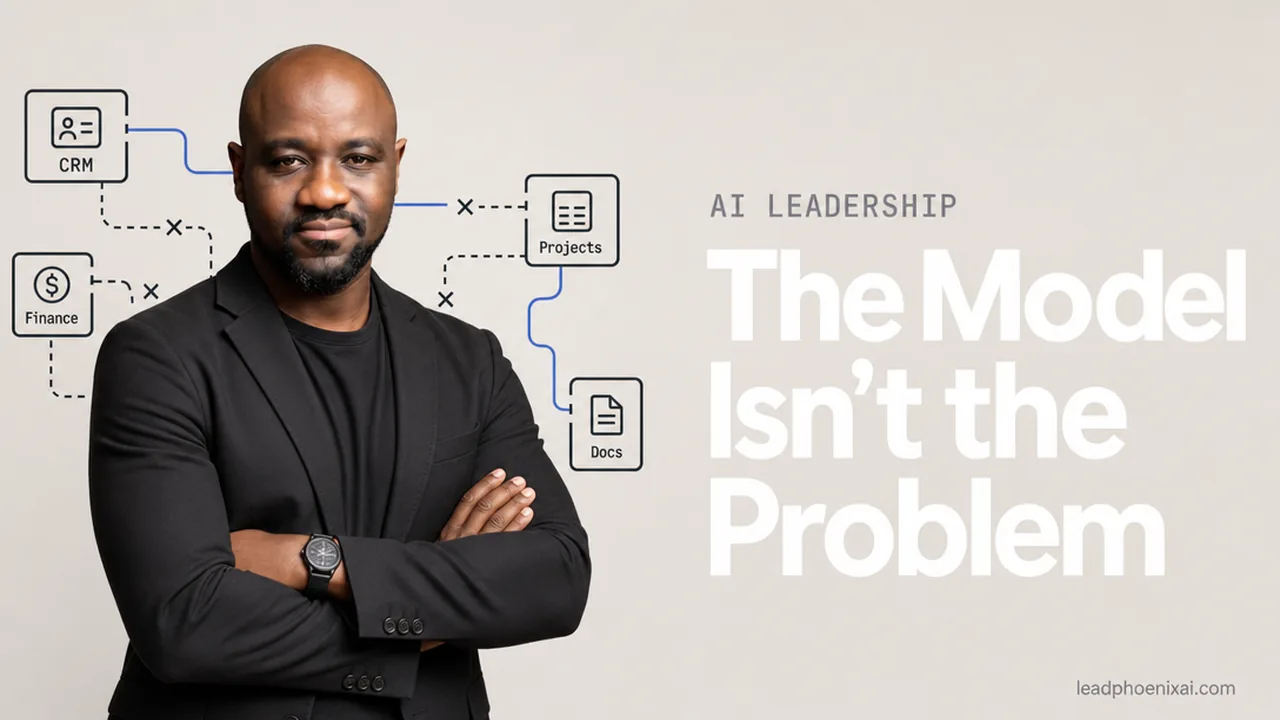
The company has tools. Usually good ones. There's a CRM, a project management system, a finance platform, and a document store. Each one is doing its job. None of them talk to each other in any meaningful way.
So when someone asks the AI a question that requires crossing two systems — "which clients are most at risk of churn based on project delays and open support tickets?" — the agent can't answer it. Not because it isn't smart enough. Because the data to answer that question lives in three different places that have never been connected.
You can't query what you can't reach.
Rita Sallam, a Distinguished VP Analyst at Gartner, put it plainly: "Agentic AI outcomes depend on context, including semantic representations of data. Without context — a clear understanding of the specific relationships and rules within an organization's data — AI agents cannot operate accurately."
The model is not the bottleneck. The access layer is.
And most organizations don't own that layer. They have a CDO title somewhere on the org chart, but without budgetary control, clear data ownership rules, or cross-functional alignment, that title is an organizational placeholder. It's not fixing the plumbing.
The Order Most Companies Get Wrong
Here's the sequence I see most often:
- Buy the tool
- Issue the mandate
- Wonder why the data isn't there
That sequence produces the Fortune 50 finance manager's situation. Copilot deployed. Mandate issued. Team trained. Still cut off at the knees.
The right order is different:
- Map what data you can actually reach today
- Pick one narrow, measurable workflow to build against that data
- Deploy the agent scoped to that workflow
- Measure the result
- Expand access and broaden the scope from there
This is what I mean when I say most companies don't have an AI tooling problem. They have an AI ownership problem. And that ownership problem includes owning the data plumbing — not just the agent layer sitting on top of it.
The source-of-truth layer isn't glamorous. Connecting your finance system to your CRM to your project management tool doesn't look like transformation from the outside. But it's the foundation everything else runs on. Without it, you're automating on top of broken or disconnected data, and the outputs will be unreliable at best, dangerous at worst.
"Wait for the API" Is a Trap
The Fortune 50 finance team is waiting for APIs that may never come. That's not a technical problem — it's a political one. Data access decisions in large organizations involve IT, security, compliance, and finance leadership, and they move slowly. Waiting for the perfect access architecture before you start is how AI mandates die quietly.
The middle path is to build against what you have.
You don't need every system connected on day one. You need to identify the two or three data sources you can actually reach, find the most painful workflow that lives inside those sources, and build a scoped agent against that workflow. Ship it. Measure it. Use the result to make the case for the next access grant.
This is the KPI-first sprint model. Pick the outcome you want to move. Map the manual work blocking it. Automate that specific bottleneck. Collect feedback. Improve. Repeat.
It's not as exciting as a company-wide transformation roadmap. But it produces results this quarter instead of waiting for a data architecture project that takes 18 months.
The Real Question to Ask Before You Buy Anything
Before you renew a license, evaluate a new platform, or expand your AI mandate, ask yourself this question:
Which data sources can our agents actually reach today, and which workflows live entirely inside those sources?
If you can answer that question clearly, you have a starting point. If you can't, that's the work. What you need is a data access audit, not model selection or vendor comparison.
Once you know what you can reach, you can scope the first agent. Once the first agent ships and produces a measurable result, you have the internal credibility to ask for the next access grant. That's how the access layer expands, not through a top-down mandate but through demonstrated value that makes the case for itself.
The companies that are actually getting ROI from AI right now are not the ones with the best models. They're the ones that did the unglamorous work of connecting their data first, scoped their first agent tightly, and measured the result honestly.
Everything else is a license fee with no output.
Frequently Asked Questions
Why do most AI mandates fail even when companies have good tools and strong executive support? The tools and the mandate aren't the constraint. The constraint is data access — agents can only work with data they can actually reach. When finance data lives in a lake with no API endpoints, or project data sits in a system that doesn't connect to the CRM, the agent has nothing to work with. Executive support doesn't fix a broken access layer. Owning the data plumbing does.
What does "build against what you have" actually mean in practice? It means auditing which data sources your team can reach today — without waiting for new API grants or a data architecture overhaul — and scoping your first agent entirely within those sources. Pick one painful workflow that lives inside the data you can already access. Build the agent against that workflow. Measure the result. Use the proof to make the case for the next access expansion.
Isn't the 95% zero-ROI figure from MIT overstated? Some practitioners argue it reflects how early most organizations are in their AI journey rather than structural failure. That's fair. But even if you cut the number in half, you still have a majority of AI initiatives producing no measurable return — and the MIT researchers are explicit that the failure is almost never the model. It's data readiness, workflow integration, and the absence of a defined outcome before build starts. The direction of the finding holds regardless of the exact percentage.
Should we wait until our data lake is fully built before deploying AI agents? No. "Wait for the API" is how AI mandates die quietly. Data access decisions in large organizations move slowly and involve multiple stakeholders. Waiting for perfect access architecture before you start means waiting indefinitely. The right move is to identify what you can reach today, scope a narrow agent against that data, ship it, and use the result to build the case for expanded access.
What's the difference between an AI ownership problem and an AI tooling problem? An AI tooling problem means you have the wrong software. An AI ownership problem means nobody inside the company is accountable for the data layer, the agent roadmap, the governance structure, and the measurable outcomes — all at once. Most mid-market firms have the tools. They're missing the owner. And without an owner, the data plumbing stays broken, the agents stay scoped to single silos, and the mandate stays stuck.
Sources
Cited inline above:
- Reddit r/CFO — Fortune 50 Finance Manager AI Access Thread
- MIT Project NANDA — Generative AI ROI Study (300+ Initiatives)
- Fortune / Gartner — Rita Sallam on Agentic AI and Semantic Data Context
Additional sources consulted for this piece:
- Forrester — Root-Cause Analysis of Enterprise AI Failures
- Folio3 — Analysis of 140 Enterprise AI Implementations
- Deloitte — 2026 State of AI in Finance Research
- EDM Association — Global Data Management Benchmark Report 2026
- Anthropic — State of AI Agents Report 2026
- Datadog — State of AI Engineering Report