The Board Pack Is Still a 3-Day Job. Here's the Workflow That Fixes That.
Most CFOs have tried AI for board pack preparation and found it underwhelming. That's because they automated the last step — narrative polish — while leaving data extraction, reconciliation, and formatting entirely manual. Here's what the full workflow actually looks like when you fix it properly.
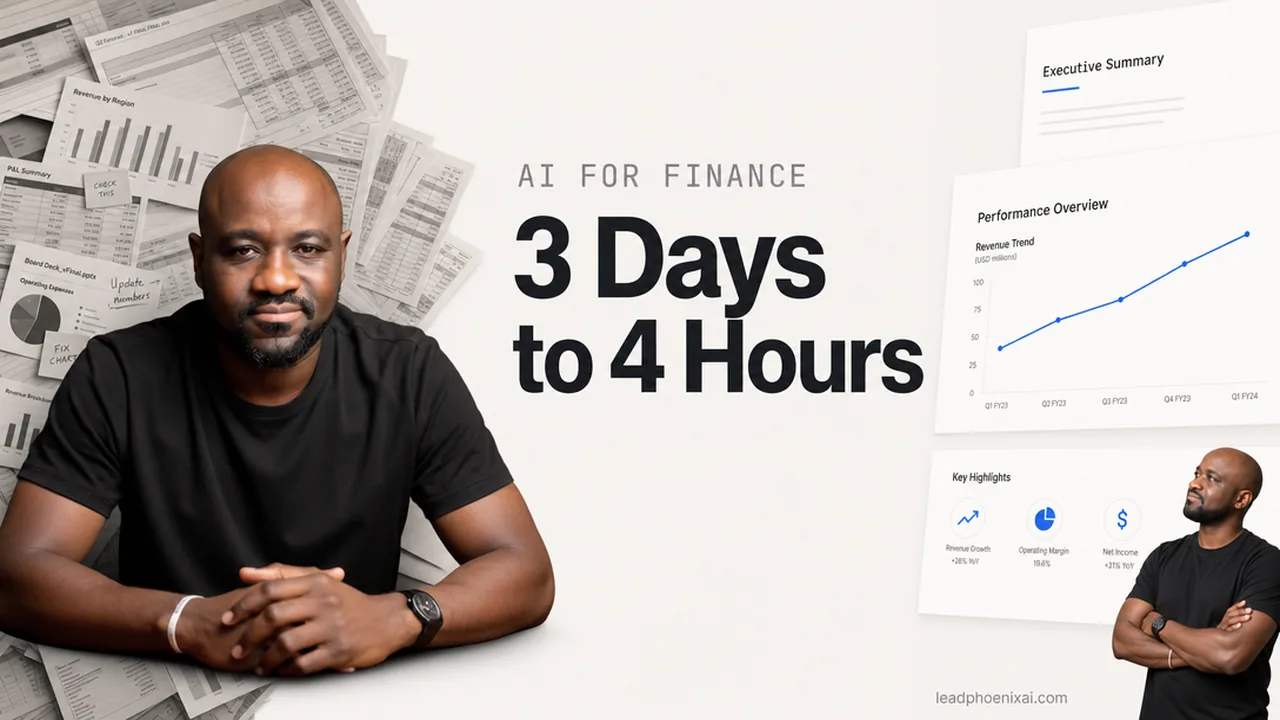
It's the night before the board meeting. For a board pack AI workflow, CFO teams do not need prettier prose first; they need cleaner construction.
You're not doing strategy. You're not thinking about what to say when the chair asks about Q3 margin compression. You're reconciling the gross margin figure across four documents because the number in the deck doesn't match the number in the financial statements, and it doesn't match the number in the committee report either.
None of those systems talk to each other. So you're the translation layer. At 10pm. Again.
That's the board pack problem. Not the writing. Not the narrative. The three days of construction work that happens before a single sentence gets drafted.
And it's more common than most CFOs will admit. Board Intelligence's 2024 survey found that only 36% of directors find their board pack useful — down from 48% the year before. The average pack is now 226 pages, up 30% since 2019. More volume, less signal, more time spent producing it.
If you've tried fixing this with an AI writing tool and found it underwhelming, I can tell you exactly why. You automated the last 20% of the problem.
Where the Three Days Actually Go
Most CFOs, when they think about the board pack, think about the narrative. The executive summary. The commentary on variance. The forward-looking language that frames what the numbers mean.
That part is maybe four to six hours of real work.
The other two and a half days? Finance professionals spend roughly 75–80% of their time on data collection and validation rather than analysis — and board pack prep is the most concentrated version of that pattern. You're pulling actuals from the ERP. Building variance commentary from scratch because last quarter's version is buried in a folder somewhere. Formatting charts in PowerPoint. Chasing the head of operations for their input. Reconciling version conflicts over email. Making sure the same number appears correctly in six different places.
None of that is CFO work. All of it is blocking CFO work.
So when someone drops an AI writing assistant into the last step — "here, use this to polish the executive summary" — they've automated the part that was already the smallest time sink. The construction work is untouched. The three days are untouched. The CFO is still the translation layer between four disconnected systems.
That's what I'mBoard calls the ceiling problem: using AI as a drafting assistant hits a limit because it automates only the final portion of the workflow while leaving the time-intensive majority entirely manual.
What the Workflow Looks Like When You Actually Fix It
The fix starts upstream. Not at the narrative — at the data.
Before any agent touches a slide or writes a sentence, the financial systems need to be connected to a single source. The ERP, the CRM if revenue data lives there, the project management tool if utilization or delivery data matters to this board. Not synced manually every quarter. Connected, so the data is live and consistent before the agent ever runs.
Once that's in place, here's what the quarterly board pack workflow looks like:
Step 1 — The agent pulls actuals from source. Not from a spreadsheet you exported. From the connected financial system directly. Revenue, margin, cash, headcount costs, whatever the board cares about. The agent knows the structure because it's been trained on two or three prior packs. It knows where the numbers go.
Step 2 — The agent builds the variance commentary. Not from scratch. From the delta between this period's actuals and the prior period, with the prior commentary as a style reference. The agent drafts in your voice because it's seen how you've framed these numbers before. It flags the variances that are outside normal range and surfaces them for your attention.
Step 3 — The agent populates the deck. Charts, tables, the financial statements section. Formatted to the board's template. Numbers consistent across every slide because they're all pulling from the same source.
Step 4 — The agent drafts the executive summary. Structured around the board's known priorities. Not generic. Shaped by what this board has asked about in prior meetings, what the chair tends to focus on, what the audit committee flagged last time.
Step 5 — You receive a draft that's 80–85% complete. Your job is not to build. Your job is to review, adjust the strategic framing on the two or three items that actually matter this quarter, sharpen the language where the agent got the tone slightly off, and approve before it goes out.
Prep time drops from three days to four to six hours. One fractional CFO practice in the UK documented this shift: board prep dropped from 14 hours to 90 minutes per cycle after implementing a connected agentic workflow.
The board gets a better pack. Not because the AI is smarter than you. Because you spent your time on what only you can do.
The Governance Layer You Can't Skip
I want to be direct about something, because I've seen this go wrong.
The suggest-and-approve loop is not optional. It's not a nice-to-have for cautious organizations. It's the operating model.
Every output the agent produces — every number, every variance call, every line of narrative — links back to the source row in the financial system. The CFO can see exactly where a figure came from. If the agent isn't sure about something, it flags it rather than guessing. That's a design decision, not a limitation.
KPMG's framework for finance AI puts it plainly: every agent output should have a named human reviewer. The agent is a contributor, not a decision-maker.
This matters for two reasons. First, the obvious one: boards and audit committees need to trust the materials they're reviewing. A pack where the CFO can't trace a number back to its source is a liability, not an asset. Second, the less obvious one: the 80–85% rule. Current AI implementations get you to roughly 80–85% of the output quality. That's not a failure — that's the design. The implementations that work are built with a human in the loop from the start, not bolted on afterward when something goes wrong.
The CFO's role shifts from constructor to editor. That's a better use of a CFO.
The Perception Gap That's Slowing This Down
Here's a number that should make every CFO uncomfortable: 51% of midmarket CFOs say they've fully adopted AI in finance. Only 19% of their Financial Controllers agree.
That 32-point gap is not a communication problem. It's a definition problem. Most CFOs who say they've adopted AI mean they've given their team access to a writing tool or a data visualization product. Their controllers know that the underlying data work — the exports, the reconciliations, the version management — is still entirely manual.
You haven't automated the board pack if you're still spending Tuesday pulling data from four systems before the AI touches anything. You've added a step.
The question worth asking is not "do we use AI?" It's "which processes no longer require a human, and where is the time we freed up actually going?"
If the answer to the second question is "back into the same manual work, just faster" — nothing has changed.
How to Roll This Out Without Breaking Anything
You don't need to rebuild your finance function to start here. The board pack is a contained, quarterly workflow with a clear before-and-after. That makes it a good first sprint.
The sequence that works:
First, audit where your board pack data actually lives. ERP, spreadsheets, email threads, department head inputs — map it before you automate anything. If the data is in four disconnected places, the agent will produce confidently wrong outputs. The source-of-truth layer comes before the workflow.
Second, pull two or three prior packs. These become the training material. The agent learns your structure, your voice, your board's priorities from the packs you've already produced.
Third, run the first cycle in parallel. The agent drafts; you also build the pack the old way. Compare. The first output won't be perfect — that's expected. The tenth output will be. The feedback loop is built in from the start.
Fourth, measure the time shift. Not just total hours saved. Where did the saved hours go? If they went back into higher-value work — strategic analysis, board relationship management, forward-looking scenario modeling — the workflow is working. If they disappeared into other busywork, you have a different problem.
The goal is not a faster board pack. The goal is a CFO who spends 80% of their board prep time on judgment instead of construction.
That's a different finance function.
Frequently Asked Questions
Does the agent need to be trained on my specific board packs, or can it use a generic template? It needs your packs. A generic template produces generic output — the agent won't know your board's priorities, your variance commentary style, or the specific metrics your chair focuses on. Two or three prior packs are enough to establish the pattern. The output quality improves with each cycle as the agent accumulates more context about what this board actually cares about.
What's the minimum data infrastructure required before this workflow produces reliable outputs? Your ERP needs to be the single source of truth for financial data, and the agent needs to read directly from it — not from a spreadsheet you exported. If your chart of accounts is inconsistent across entities, or if revenue data lives in a CRM that doesn't sync with your ERP, fix that first. Automating on top of disconnected or inconsistent data produces confidently wrong outputs faster. The source-of-truth layer is non-negotiable infrastructure.
How do boards and audit committees react when they find out materials were AI-drafted? The ones who react badly are usually reacting to a governance gap, not to AI itself. If the CFO can trace every number back to its source, show the review trail, and explain what was changed between the agent's draft and the final pack — most boards are fine with it. The disclosure conversation goes better when you lead with the governance model: "AI prepares the first draft; I review and approve every figure before it reaches you." That's a stronger answer than "we didn't use AI."
Can this workflow be implemented without a dedicated board portal product? Yes. A connected LLM with access to your financial data, trained on prior packs, and outputting to your existing slide template is sufficient for most mid-market firms. Dedicated board portal products add version management and director access features that matter at larger organizations. For a $50M–$200M firm, the workflow design matters more than the portal.
What's a realistic timeline from starting the setup to having a working first draft? For a firm with a reasonably clean ERP and two or three prior packs available, the first working draft typically takes two to four weeks to set up — one week to connect the data source and configure the agent, one to two weeks to train on prior packs and run a test cycle, and a final week to refine based on the CFO's feedback. The first output won't be production-ready. The second or third cycle usually is.
Sources
Cited inline above:
- Board Intelligence — 2024 Board Effectiveness Survey
- I'mBoard — Board Pack Automation Practitioner Guidance
- ScaleWithCFO — Agentic CFO Workflow Case Study
Additional sources consulted for this piece:
- EY — CFO AI Adoption Study 2024
- KPMG — Finance AI Governance Framework
- CFO Pro Analytics — CFO AI Agent Board Reporting
- The CFO — Midmarket AI Adoption Survey
- Diligent — Board Pack AI Features Research
- BCG — The CFO's AI Agenda: From Automation to Advantage
- Chartered Governance Institute — Board Materials Effectiveness Research
- CFO Secrets — The Two Hats of the CFO Framework
- Workday — AI Agents in Finance Survey