How to Stop AI From Hallucinating Your Financials: A CFO's Guide
AI hallucination in finance isn't a product defect. It's what happens when a probabilistic tool gets handed a job that needs a guaranteed answer. Here's the distinction that fixes it.
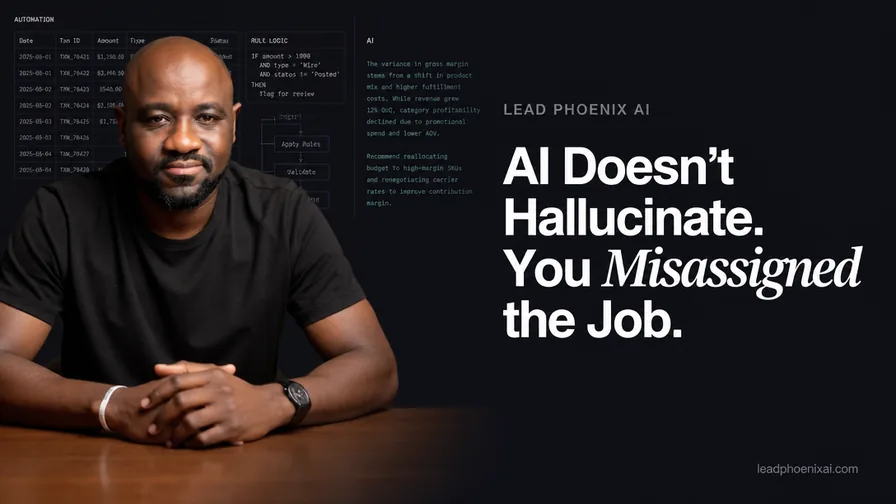
You walk into the board meeting with a variance analysis your team ran through an AI tool. The numbers look clean — well-formatted, clear narrative, everything adds up. Halfway through the presentation, the CEO asks about one specific line item. You pull up the source data to show your working.
The number doesn't match. That's AI hallucination — and it just happened in front of your board.
The AI had filled a gap in the underlying data with a plausible-looking figure. It didn't flag the estimate or ask a clarifying question — it just completed the output and moved on. Your team hadn't caught it, and you're catching it now, in the room, in front of the board.
That moment — that specific kind of AI hallucination — is what makes CFOs hesitant to trust AI with their numbers. It's a legitimate fear. But the thing most finance teams get wrong is what actually caused it.
AI didn't hallucinate because it was broken. It hallucinated because someone gave a probabilistic tool a job that needed a guaranteed answer. That's a design error, not a product defect. And it has a fix.
Automation and AI are not the same thing
Most people treat them as interchangeable. They're not — and that mix-up is where almost every hallucination problem in finance starts.
Automation is deterministic. You define a rule once: if the invoice total is more than 5% above the purchase order, flag it for review. The system runs that rule the same way every single time. The output is guaranteed within the logic you set. You can audit it, test it, and stand behind it.
AI is probabilistic. A language model predicts the most likely output based on the input and context it's given. It's genuinely good at reasoning through ambiguous situations — drafting board commentary, summarizing what a set of variances means in plain English, spotting patterns in unstructured data. What it's not built to do is guarantee that a number is correct. That's not how probabilistic systems work.
Here's the clearest way I know to show the difference — and CFO Secrets ran this exact experiment to prove it. Give an AI model a complex calculation and ask it to reason through it. It'll produce an answer — usually close, occasionally wrong, always confident. Now set it up to route calculation tasks to a calculator instead of reasoning through them itself. The model handles the interpretation. The calculator handles the arithmetic. Hallucination disappears from the math — not because the model got better, but because the math stopped going through a probabilistic system.
That's not a workaround. That's the right architecture.
What this looks like in a real finance team
A $40M advisory firm wanted to use AI to speed up its monthly close. First attempt: an AI assistant cross-referencing transactions against budget lines and flagging variances. The outputs looked good — coherent, well-formatted. They were also wrong in ways subtle enough to survive a first pass.
The fix was straightforward. Split the work into two piles.
Reconciliation, transaction matching, variance calculation — anything that needs to be arithmetically defensible — went into automation. Structured rules, deterministic logic, and full traceability, with no AI reasoning anywhere near the numbers.
Drafting the management commentary, summarizing where variances came from, flagging which client situations needed a call — that went to AI. Pattern recognition and language, where the goal is "clearly written and directionally useful," not "certified accurate."
Once the work was split correctly, the hallucination problem disappeared. Not because the model got better — because it stopped being asked to do something it was never built for.
What changes when you get this right
The CFO's relationship with AI stops being adversarial. AI doesn't get removed from the finance function — it gets scoped to the work where it actually belongs. (For a look at what purpose-built finance AI agents can do, Anthropic's recent finance agent launch is a useful frame.) Automation handles what needs to be guaranteed. AI handles what needs to be synthesized.
The close gets faster because routine matching and rule-based checks run without anyone touching them. Your attention goes toward the judgment calls the numbers raise — board conversation, strategic implications, decisions that actually need a senior finance leader in the room. That's what the role is for.
Auditing becomes straightforward too. An automation rule either ran or it didn't — you can trace it in seconds. An AI-generated summary is a draft your team reviews, not a certified figure. Different outputs, different standards. Both make sense for what they are.
The actual problem most firms have
Getting this right isn't about finding a better AI product. It means mapping which workflows belong in which category, building the automation layer with proper rules and traceable logic, and scoping AI to the work that genuinely benefits from it — the same approach behind KPI-first AI sprints: pick the outcome, pick the right tool, measure the lift.
That's where most mid-market finance teams get stuck — the same pattern behind why 85% of firms want AI agents but only 21% are ready to deploy them. Not because the work is hard — because nobody owns it. There's no one accountable for drawing the line between "this needs a rule" and "this needs a reasoning model" and then making it happen.
At LeadPhoenix AI, this is the first thing we work through with CFOs and finance teams. A two-week AI Readiness Audit maps your highest-value processes, separates what belongs in automation from what belongs in AI, and gives you a 90-day implementation roadmap with ROI estimates per use case.
If your team has been burned by hallucination — or is holding back on AI because of it — the question to start with isn't "which AI tool do we buy?" It's "which of our workflows need guaranteed outputs, and are we using the right system for each one?"
Book a discovery call to start that conversation.
Frequently Asked Questions
What does AI hallucination actually mean for a finance team?
AI hallucination in finance happens when a language model fills gaps in data or calculations with plausible-looking outputs it can't verify. Unlike a human error, an AI hallucination often looks clean and well-formatted, making it harder to catch before it reaches a board deck or an auditor.
Which finance tasks should use automation vs. AI?
Deterministic work that needs a guaranteed answer — reconciliation, invoice matching, variance flagging, rule-based alerts — should run through automation. AI works best on synthesis and language tasks: management commentary, variance narratives, client summaries, and pattern identification across unstructured data.
Won't a better AI model eventually solve the hallucination problem?
Not for deterministic finance tasks. Hallucination isn't a quality flaw that model improvements will eliminate — it's a property of probabilistic systems. The fix isn't waiting for a better model; it's routing arithmetic and rule-based work to deterministic tools while reserving AI for synthesis work.
How long does it take to properly categorize finance workflows?
For most mid-market firms, a two-week AI Readiness Audit maps the highest-value processes, categorizes each as automation or AI, and produces a 90-day implementation roadmap with ROI estimates. The categorization isn't complicated — the challenge is having someone who owns the decision.
Our firm already has ChatGPT licenses. Does that count as an AI strategy?
ChatGPT licenses give your team a capable reasoning tool, but they don't solve the categorization problem. Without a clear split between workflows that need automation and those that benefit from AI — and a reliable data layer underneath both — the hallucination risk stays high.
Does this framework apply to CPA and advisory firms?
Exactly the same framework applies. CPA firms use automation for transaction matching, reconciliation, and engagement letter generation, while AI handles management commentary, advisory opportunity identification, and client communication drafts.