Anthropic Just Shipped 10 Finance Agents. The Real Story Is Underneath the Marketplace.
Anthropic shipped 10 finance agents, Microsoft 365 add-ins, and an agent marketplace. The marketplace gets the headlines. The MCP connectors are what's useful.
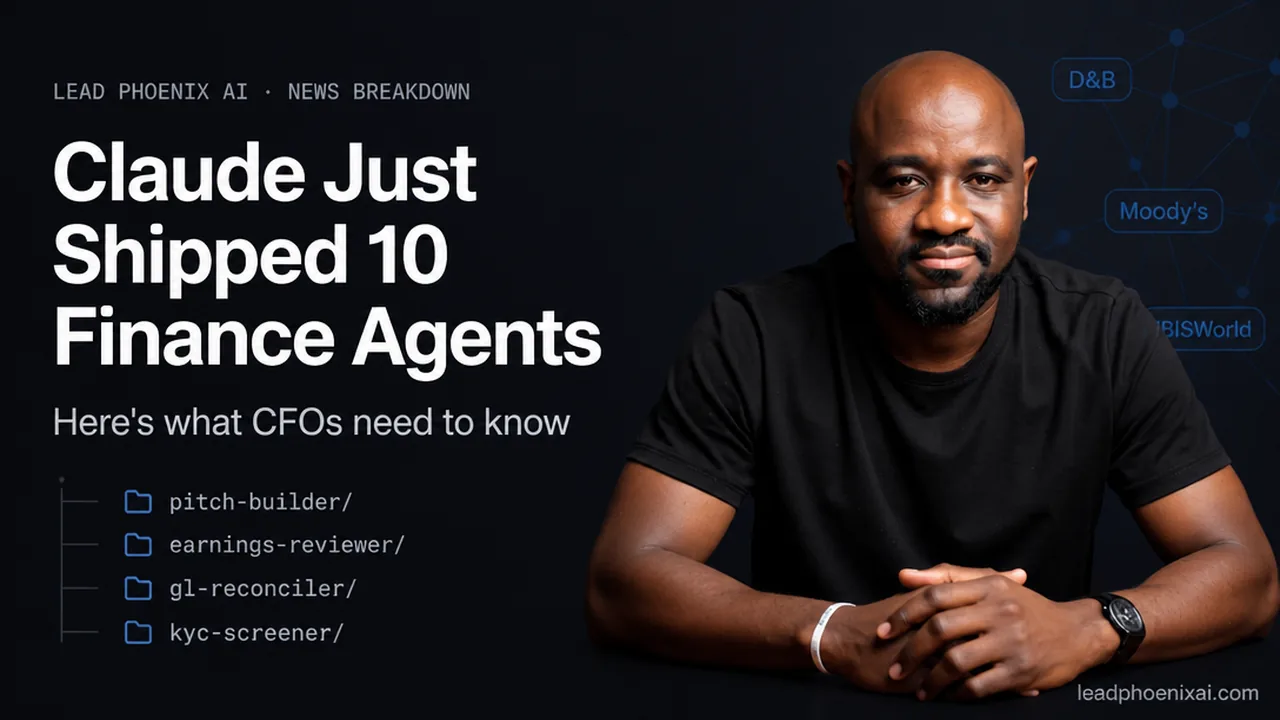
Anthropic just shipped its Agents for Financial Services launch — 10 ready-to-run finance agents, Microsoft 365 add-ins, and a public agent marketplace. The headlines will focus on the marketplace. The part that actually matters for a mid-market firm is buried two paragraphs into the announcement.
This post breaks down what was announced, what most CFOs will misread, and where the value actually lives.
What Anthropic actually shipped
The announcement, dated May 5, 2026, has four distinct pieces. Most coverage treats them as one thing. They are not.
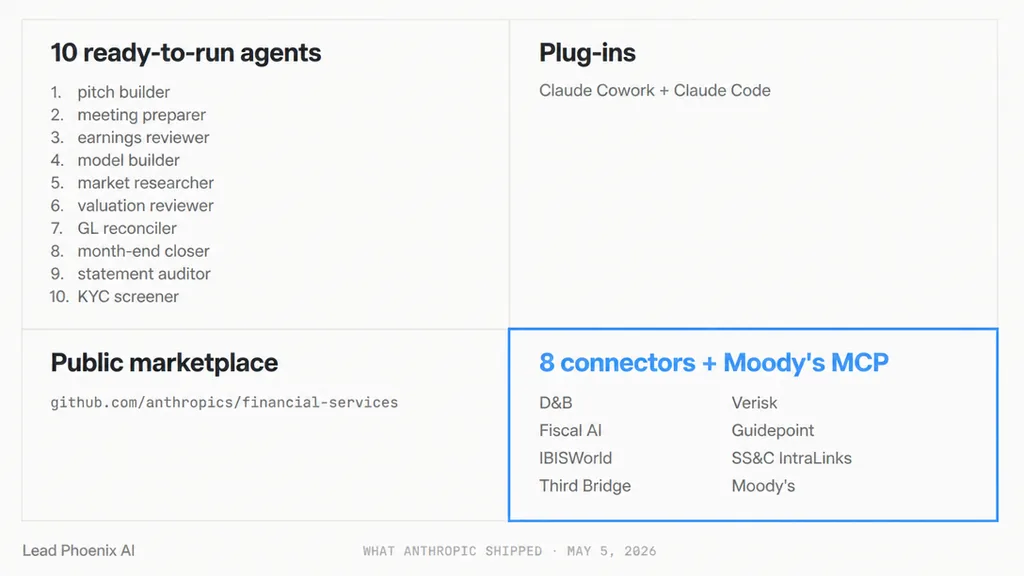
First, there are 10 ready-to-run agents covering both sides of finance work. Five sit on the research and client-coverage side: a pitch builder, a meeting preparer, an earnings reviewer, a model builder, and a market researcher. Five sit on the finance and operations side: a valuation reviewer, a general-ledger reconciler, a month-end closer, a statement auditor, and a KYC screener. These are not chat templates. They are agents that take an instruction, run a process, and produce an output that feeds a real workflow.
Second, those agents ship as plug-ins inside Claude Cowork and Claude Code. Anyone on a paid plan can install them and start running them. No code required.
Third, the agents are also published in a public repository — Anthropic calls it the "financial services marketplace" — at github.com/anthropics/financial-services. This is the part the press is calling a marketplace. We will come back to it.
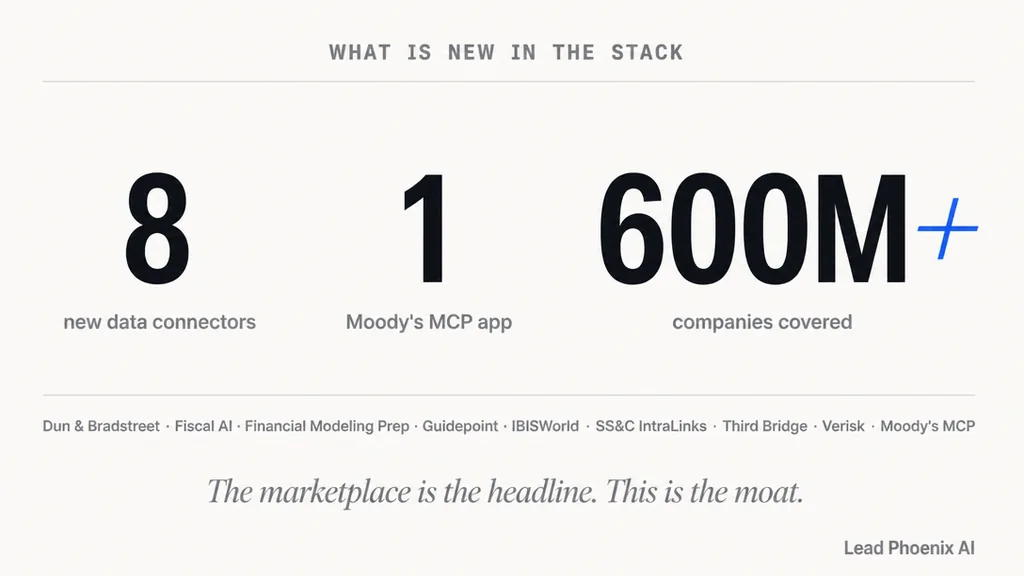
Fourth — and this is the part that actually matters — Anthropic shipped eight new data connectors and one MCP app. The connectors give the agents governed real-time access to Dun & Bradstreet, Fiscal AI, Financial Modeling Prep, Guidepoint, IBISWorld, SS&C IntraLinks, Third Bridge, and Verisk. The MCP app exposes Moody's data on more than 600 million companies. There is also a new Microsoft 365 integration that carries context across Excel, PowerPoint, Word, and Outlook.
That last piece is where the value lives.
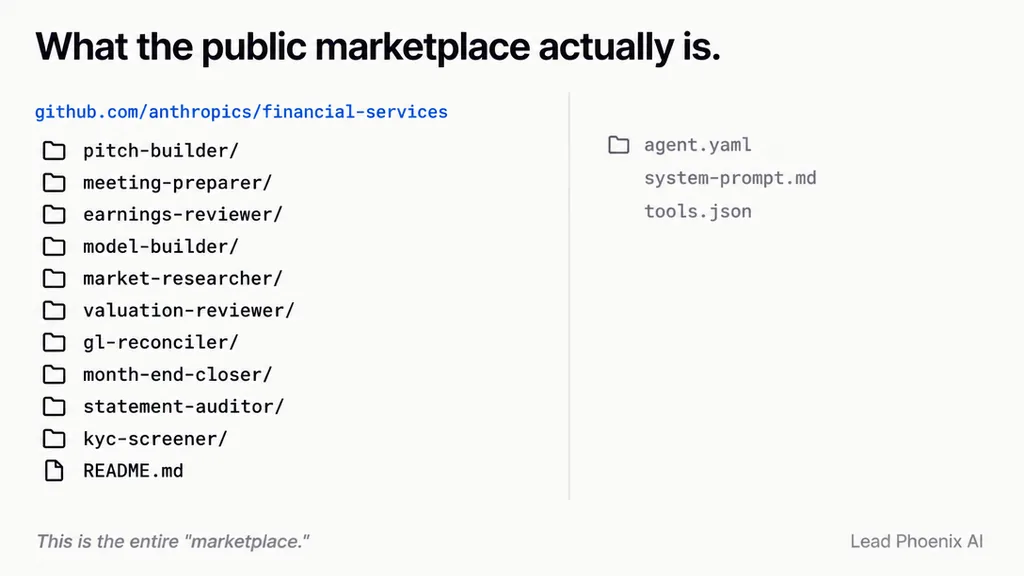
The marketplace is a GitHub repository
Let me name what is actually there.
Anthropic's "agent marketplace" is github.com/anthropics/financial-services. It is a public Git repo. Each agent is a folder with a YAML config, a system prompt, and some tool definitions.
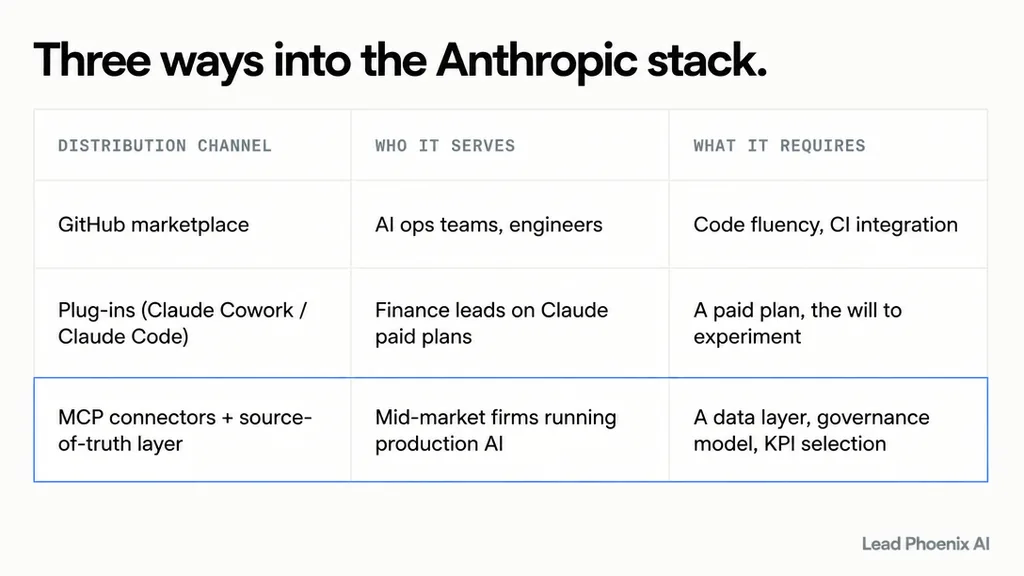
For an engineer or AI-ops team, that is exactly the right primitive. You can fork it, version-control your customizations, audit every change, and deploy through your existing CI. Clean.
For a mid-market managing partner, CFO, or finance lead, it is not a marketplace in the consumer sense. There is no install button, no rating system, no support tier. It is a set of files. If you have never opened GitHub before, this is not where you start your AI strategy.
This is the standard misreading of the announcement. The press will call it a marketplace. The mid-market buyer will assume it works like the App Store. It does not.
The plug-ins are the bridge
The plug-ins fix this — partially.
Inside Claude Cowork or Claude Code, you can install any of the 10 agents with a click. The plug-in handles configuration, integration with your account, and the connection to whichever data sources you have enabled. For a finance team already on a Claude paid plan, this is genuinely usable on day one.
The catch: the plug-ins still require someone to set up the data connections, decide which agents fit which workflows, and define the governance around who can run what against which data. The plug-in clicks. The operating model does not.
So the plug-ins solve the "I cannot read GitHub" problem. They do not solve the "I do not yet have a data layer or a governance model" problem.
The data connectors are what matters
Now the actual story.
Eight new data connectors plus a Moody's MCP app means an agent can pull live, governed data from the systems CFOs and analysts already rely on. D&B for company files. Fiscal AI for fundamentals. IBISWorld for industry research. Third Bridge for expert calls. Verisk for risk data. Moody's for credit and entity data on more than 600 million companies. SS&C IntraLinks for deal-room and document workflows.
This matters for one reason: it closes the gap between "the agent can do the work" and "the agent can do the work on my actual data." Every prior wave of AI-for-finance pilots hit this wall. The demo used a clean test dataset. Production used your real, fragmented systems and the output became unreliable.
The MCP connector design is what fixes that. Each connector is a stable, governed bridge between the agent and a data source. The agent does not scrape, does not download, and does not store the underlying data. It queries through a defined contract. That is the difference between a parlor trick and a workflow you can run in front of an audit committee.
This is the part of the announcement that most directly serves a mid-market firm. Not the marketplace. The connectors.
What this means for mid-market CFOs and managing partners
If you run finance at a $50M to $500M firm, the practical read is:
- The 10 agents are useful starting points but not the strategy. Treat them as templates, not the answer.
- The plug-ins make day-one experimentation feasible without an engineering team. Install one, run it on a low-stakes workflow, see how the output feels.
- The MCP connectors are the moat. The firm that wires its agents into Moody's, D&B, IBISWorld, Third Bridge, and its own internal source-of-truth layer will produce work the firm without those connectors cannot produce.
- The Microsoft 365 add-ins matter more than they look. Most finance work happens in Excel, PowerPoint, and Word. An agent that carries context between those tools is meeting the team where they already work — and adoption follows.
If you have read our work on KPI-first AI sprints, the right move here is the same shape. Pick two finance KPIs that one of the 10 agents could actually move — close cycle time, valuation review turnaround, KYC onboarding speed. Wire that agent to your real data through the relevant MCP connectors. Run the workflow with a human reviewer in the loop until trust is earned. Then graduate.
The LeadPhoenix take
The marketplace will get the headlines. The MCP connectors will move the money.
For a mid-market firm, the announcement is not a "should we use Anthropic's agents?" decision. It is a "do we have the data layer and the governance model to make any of these agents reliable on our real data?" question. If the answer is no, the 10 agents are demos. If the answer is yes, the 10 agents are operating leverage.
Most mid-market finance functions are not yet in the second camp. Their data lives across an ERP, a billing system, a CRM, a few spreadsheets, and three partners' inboxes. Plugging an Anthropic agent into that fragmentation produces fast, fragmented output. Building the source-of-truth layer underneath first — and then plugging the agent in — produces something different.
If you are a CFO, finance lead, or operating partner trying to figure out where to start with the Anthropic agent stack — what to install first, which connectors actually move the work for your firm, and what the governance model needs to look like before any of it ships into production — that is exactly the conversation an AI Readiness Audit is built for.
Frequently Asked Questions
Which of Anthropic's 10 finance agents should a mid-market CFO try first?
For a mid-market CFO, start with the GL reconciler or month-end closer — these map to high-frequency, measurable workflows that require the least contextual judgment from the agent. Once one workflow is producing reliable output, layer in the KYC screener or statement auditor.
What is the difference between the Anthropic agent marketplace and the MCP connectors?
The marketplace is a public GitHub repo of YAML configs and system prompts — a starting point for engineers, not a consumer app store. The MCP connectors are governed data bridges that give agents live access to Moody's, D&B, IBISWorld, and seven other systems CFOs already pay for. The connectors are what turn a demo into a production workflow.
Do you need an engineering team to use Anthropic's finance agents?
Not for the plug-in layer. The 10 agents ship as one-click plug-ins inside Claude Cowork and Claude Code on any paid plan. Where engineering support matters is in wiring the MCP connectors to your specific data stack — that setup typically takes 30 to 60 days for a mid-market firm.
How is this different from building finance workflows with ChatGPT or Microsoft Copilot?
The gap that matters is not LLM quality — it is governed data connectivity. The Anthropic MCP connectors give agents structured access to financial data systems CFOs already use. ChatGPT and Copilot are general-purpose tools without that connector layer, which means production output depends on how clean and accessible your underlying data is.
Where should a mid-market finance team start with the Anthropic agent stack?
Start with one workflow and one KPI. Pick the agent that maps to a measurable bottleneck — close cycle time, KYC turnaround, or valuation review speed — and wire it to the relevant data connector. Run it with a human reviewer in the loop for 30 days before removing that oversight.