The Board Doesn't Want an AI Forecast. They Want to Know Where Yours Was Wrong.
Every FP&A vendor is selling AI that builds your financial model faster. The board isn't asking how fast you built it. They're asking where you were wrong last quarter and what you're doing about it. Here's the reframe that actually matters.
CFO Connect ran a live audit of Microsoft Copilot building a three-scenario financial model. Best case, base case, worst case — the whole thing.
Copilot generated the scenarios by applying hardcoded multipliers directly to output cells. 1.35x for best. 0.65x for worst. No assumption page. No scenario switch. No connected logic. Just multipliers baked into the outputs.
Then the balance sheet didn't balance. Copilot had grown "other long-term assets" over time without recording a corresponding cash outflow. Assets increased. Nothing offset them. The model looked complete and professional. It was structurally broken.
The line from that audit that I keep coming back to: AI doesn't get it wrong tentatively. It gets it wrong confidently.
That's the problem with the myth that AI's job in FP&A is to build your financial model faster.
The Myth, Stated Plainly
Every FP&A software vendor right now is selling some version of the same thing: AI that generates scenarios, builds forecasts, and cuts model-building time. The pitch is speed. The implication is that faster model-building is the bottleneck in your finance function.
It isn't.
The bottleneck is not how long it takes to build the model. The bottleneck is how long it takes to understand why the last one was wrong, and whether you can explain that clearly enough that the board trusts the next one.
Boards don't ask how fast you built the forecast. They ask where the company is versus plan, why it deviated, and what it means for the rest of the year. That's the artifact they want. That's the conversation they're prepared to have.
AI that builds models faster doesn't answer any of those questions.
Why the Time Savings Aren't Real
Try using AI to build a model from scratch and the same pattern shows up.
The AI produces something that looks right. The structure is in place and the tabs are labeled the way you'd expect. Then someone starts checking it. They find a formula that's hardcoded where it should be dynamic. They find a scenario assumption that's a percentage of revenue when it should be a fixed cost. They find a balance sheet that doesn't balance.
They spend the next two hours fixing it.
Workday's own research found that employees spend the hours AI supposedly saves correcting errors, rewriting low-quality outputs, and verifying results. Ian Schnoor at the Financial Modeling Institute put it plainly: users still have to "check it, audit it, challenge it, design it, structure it" until they're as confident in the model as if they'd built it themselves.
At that point, what exactly did AI save you?
The speed promise collapses under the weight of the verification burden. And that's before you consider what happens if you don't catch the error and present a structurally broken model to your board.
What Boards Actually Want
Gartner surveyed finance leaders and found that 66% expect the most immediate GenAI impact to come from explaining forecast and budget variances — not from building models faster.
That number tracks with what I see in practice. The CFO of an energy software company described it this way in L.E.K.'s 2025 Office of the CFO Survey: "It flags anomalies and helps us pinpoint variances faster, which has cut down our month-end timeline and frees up our team to focus on more analytical work."
Notice what she didn't say. She didn't say AI built her model. She said it helped her team understand where to dig in.
That's the right use case. And it maps directly to what boards are actually asking for.
FP&A Trends put it well: "Forecast accuracy is not the important item and not worth the debate as long as you have a sound process — the key is variance analysis: understanding why deviations occurred."
The board doesn't need a more accurate forecast. They need a rigorous accounting of where the last forecast was wrong, why it was wrong, and what that tells you about the assumptions you're carrying into the next one.
The Reframe: AI as Model Challenger, Not Model Builder
A different framing works better.
You keep authorship of the assumptions. You know your business. You know your customer concentration and the way Q3 seasonality shapes your COGS curve. No AI tool trained on industry benchmarks knows any of that. The assumptions stay with you.
What you give the agent is your history. Eight to twelve quarters of actuals, plus whatever forecast and assumptions you're currently working from.
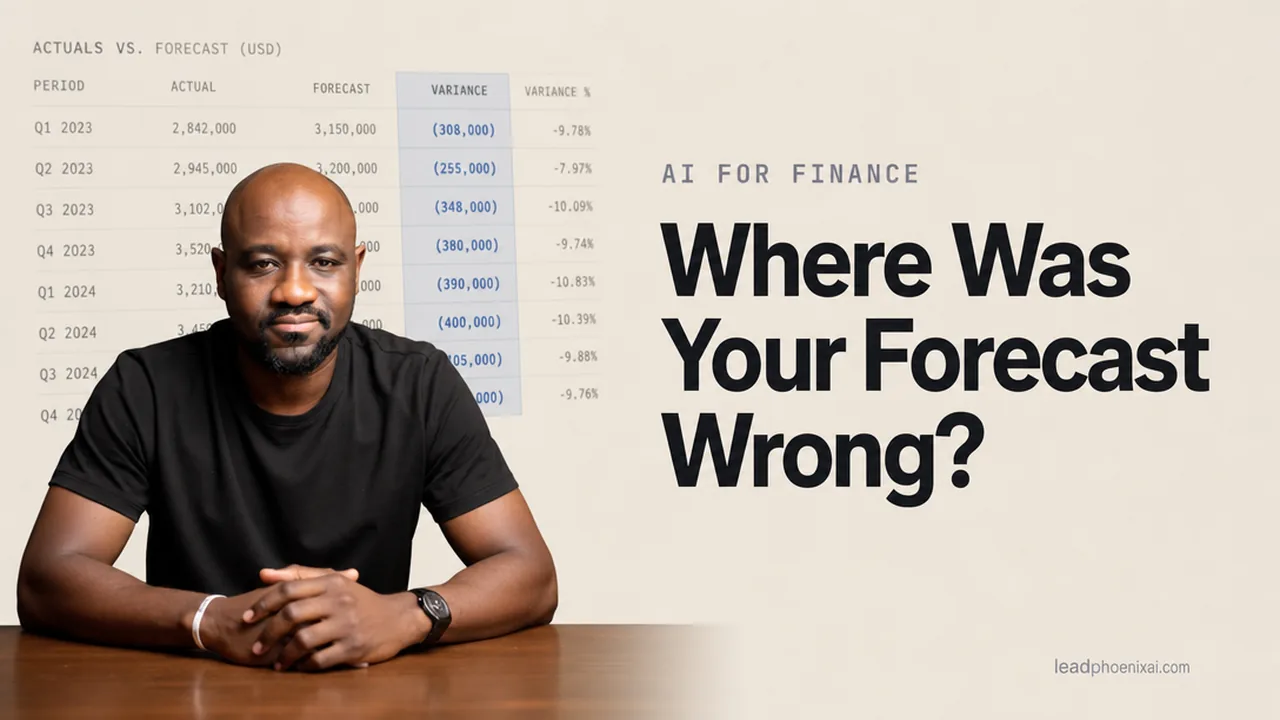
The agent's job is not to build a new model. Its job is to audit the one you have against what actually happened. Where have your revenue assumptions been consistently optimistic? Where have your cost assumptions been consistently conservative? Which line items have the widest variance between forecast and actual, quarter after quarter?
The output is a variance memo. Not a new forecast. A structured accounting of where your model has been wrong, by how much, and what the pattern suggests about the assumptions you should revisit before you present to the board.
That's the artifact boards want. And it's grounded entirely in your numbers, not generic benchmarks.
Precanto describes this architecture as a "challenger model" — one that processes historical actuals and relevant drivers to generate independent forecasts, specifically to highlight where current models fail and where they can be improved. The goal isn't to replace the CFO's judgment. It's to give that judgment a harder surface to push against.
The Governance Question You Can't Skip
There's one more reason the "AI builds the model" approach is the wrong default, and it's not about accuracy.
Deloitte's 2026 Tech Trends report found that 80% of companies deploying AI agents lack a mature governance model. Finance teams are building AI workflows faster than compliance can vet them.
A model built by AI, with hardcoded assumptions and no connected logic, is not auditable. When the board asks "how did you get to this number," the answer can't be "the AI generated it." That's not a defensible position in a board meeting, and it's not a defensible position in an audit.
The model challenger architecture is auditable by design. The CFO's assumptions are explicit and documented. The agent's variance analysis cites the source data. Every number links back to a quarter of actuals. The human signs off on the interpretation before it goes to the board.
That's not just better FP&A. It's the only version of AI in finance that survives contact with a serious governance question.
What to Do This Quarter
If you've tried AI model-building tools and concluded they don't know your business, you're right. They don't. That's not the use case.
The use case is this: pull your last eight quarters of actuals. Pull your current forecast and the assumptions underneath it. Feed both to an agent and ask it one question — where has this model been wrong, and by how much?
You don't need a new model. You need a harder look at the one you have.
That's the conversation your board wants to have. And it's the one AI can actually help you prepare for.
If you want to see what this looks like in practice for a mid-market finance team, our AI Readiness Audit maps your highest-ROI AI use cases to your actual stack and workflows, including where variance intelligence fits into your existing FP&A process.
Frequently Asked Questions
Why can't AI just learn my business's specific assumptions over time? It can, but only if you feed it your own historical data — not industry benchmarks. The tools being marketed as AI model builders typically use external data and generic assumptions as their starting point. An agent trained on your own 8–12 quarters of actuals will reflect your specific cost structure, seasonality, and customer patterns. The difference is architecture: you have to build the system around your data, not the vendor's.
How many quarters of historical data do I need before an AI challenger agent produces reliable variance patterns? Eight quarters is a reasonable floor for businesses with relatively stable models. If your business has gone through a structural change — an acquisition, a pivot, a COVID-era anomaly — you'll need to flag those periods explicitly so the agent doesn't treat them as representative. The more consistent your historical operating model, the faster the patterns become statistically meaningful.
Is there a tool that natively supports the actuals-plus-assumptions-to-variance-memo workflow? Not cleanly, as of mid-2026. Most FP&A platforms (Mosaic, Pigment, Anaplan) are moving toward AI-assisted variance flagging, but the full "feed your actuals, audit your assumptions, produce a board-ready memo" workflow typically requires custom agent architecture on top of your existing stack. That's the gap we build into.
What's the difference between AI flagging a variance and a CFO explaining one? AI can surface the pattern — revenue was 8% below plan for three consecutive quarters, and the gap was concentrated in enterprise deals. The CFO explains what it means: two specific deals slipped, both are expected to close, and full-year revenue will land within 2% of plan if they do. The agent handles the detection. The CFO handles the interpretation. That division of labor is the point.
Doesn't a faster model still have value even if it needs correction? Only if the correction time is genuinely shorter than building from scratch. The evidence suggests it usually isn't — the verification burden consumes most of the time saved. Where speed genuinely matters is in variance detection and anomaly flagging, not in initial model construction. Use AI where it's fast and reliable; keep human authorship where judgment is the product.
Sources
Cited inline above:
- CFO Connect — Live Audit of Microsoft Copilot Financial Model
- Workday — AI Productivity Report 2026
- L.E.K. Consulting — 2025 Office of the CFO Survey
- FP&A Trends — Forecast Accuracy and Variance Analysis
Additional sources consulted for this piece:
- Gartner — Finance AI Survey 2025
- Financial Modeling Institute — AI in Financial Modeling Webinar (Ian Schnoor)
- BCG — CFO AI Agenda, April 2026
- AFP — Treasury Benchmarking Survey 2025
- Precanto — AI Challenger Model for Headcount and Spend
- Everworker — FP&A Practitioner Guide
- Deloitte — 2026 Tech Trends Report
- ServiceNow — CFO Outlook 2026 (Gina Mastantuono)
- Fathom — Board Variance Narrative Examples
- Forecastio — Sales Forecasting Accuracy Guide 2026