The Covenant Monitor: From Month-End Discovery to Continuous Headroom
Most CFOs find out they're close to a covenant breach at month-end, when the controller emails a number. Here's what the workflow looks like when an agent owns the watch instead.
Most Month-Ends Look Like This
Your controller pulls the actuals. Runs the spreadsheet tab. Emails you a number.
If the number is close, you call the banker. If you're traveling, the email sits.
That's covenant monitoring at most mid-market companies right now. And it's structurally backward-looking in a way that creates real risk — not theoretical risk, real risk.
Here's a scenario that's documented, not invented. A $200M lender's operations team was reviewing covenants manually. An EBITDA drop pushed Net Leverage to 4.7x. The breach went unnoticed for over a month. The borrower kept drawing funds. By the next quarter, leverage was 5.2x and the lender had almost no options left. The breach wasn't hidden. It was invisible because nobody was watching between reporting periods.
That's the borrower-side version of the same problem. You don't find out you're close until you're close. And by then, the window for a clean waiver conversation has narrowed considerably.
Grant Thornton's IFRS guidance puts it plainly: "By the time you complete your end of year assessment of covenant compliance, it might be too late to obtain a pre-year end waiver as the waiver must be received before period end."
That's not a process failure. That's what the process was designed to produce.
Why This Is a CFO Problem, Not a Controller Problem
Before we get into what changes, it's worth being clear about why this matters at the CFO level specifically.
Covenant compliance is binary in spreadsheets: pass or fail. The cushion gets thinner over months and nobody notices because nobody is computing it weekly. Then one quarter the value crosses the threshold and the team scrambles.
That scramble is not a controller problem. It's a board-level fiduciary event.
CMS Law's leveraged finance briefing is direct about this: "A director's fiduciary duties can change depending on how high the risk is that the company may fail. There can come a point at which the directors are obliged to have regard to the interests of the lenders alongside the interests of the shareholders."
When headroom is thinning, the CFO's job is to know about it before the board does, not to find out alongside them. That's the governance gap the current workflow creates.
Most PE-backed companies with multiple credit facilities have no centralized covenant registry. Definitions live in different credit agreements. Thresholds were negotiated at different times. Amendment riders have modified original terms. The controller is doing their best with a spreadsheet that was never designed for continuous monitoring.
The CFO ends up owning the risk but not the visibility. That's the problem we're solving.
Here's What Changes
The new workflow has three distinct pieces. They're not complicated individually. The value comes from running them together, continuously.
Piece 1: The agent ingests the loan agreement once.
Every covenant definition, every threshold, every calculation methodology gets extracted from the PDF and structured into a format the agent can work with. Amendment riders get layered in. If there are multiple facilities with different definitions of EBITDA or Net Leverage, those get mapped separately.
This is the unglamorous work that makes everything else possible. You do it once. The agent carries it forward.
Piece 2: The agent connects to your GL or ERP and monitors headroom on a rolling basis.
Not monthly. Continuously.
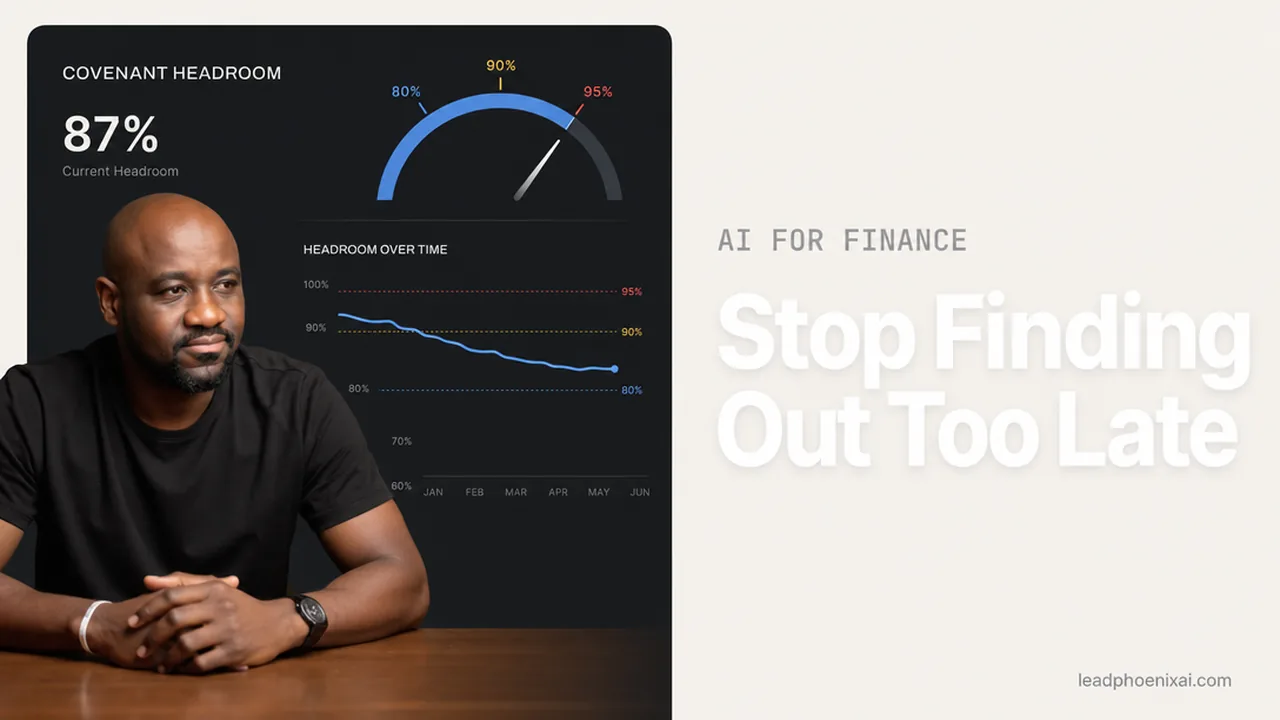
The alert architecture matters here. The right design isn't binary — it's tiered. Alerts fire at 80% of the covenant limit, again at 90%, and again at 95%. Each threshold gives the CFO a different planning window and a different set of options.
At 80%, you're watching. At 90%, you're modeling scenarios. At 95%, you're drafting the conversation with your banker.
The scenario modeling is where this gets genuinely useful. The agent isn't just telling you where you are. It's showing you where you'll be under base, stress, and downside assumptions. "If revenue drops 10% next quarter, here's what happens to Net Leverage." That's the question you should be asking at every board meeting. The agent runs it automatically.
Piece 3: When a threshold is approached, the agent drafts the lender communication.
It's in your voice, drawing on your prior correspondence with this lender, with the relevant covenant calculations attached.
You review it. You approve it. You send it.
The agent doesn't send anything. That's not a limitation — that's the design. Lender communications are high-stakes external commitments. The CFO's judgment, the CFO's relationship with the banker, and the CFO's read on timing all belong in that decision. What the agent removes is the 4-hour scramble to draft something coherent under pressure.
As one practitioner put it: "While AI can recommend an action, the final decision must remain with the human."
That's exactly right. The agent prepares the work. The CFO approves the sensitive decision. That's the governance model.
What the Lender Actually Wants
This is worth saying directly because it changes how you think about the value of early flagging.
Lenders strongly prefer proactive borrower communication when headroom is thinning. The waiver is most likely to be granted when the breach is narrow and the borrower surfaces it first. Nilus's PE-backed CFO playbook names it explicitly: the first thing lenders want to see when headroom is thinning is that you identified the issue early.
The CFO who calls the banker at 85% headroom with a scenario model and a draft amendment proposal is having a completely different conversation than the CFO who calls at 98% headroom because the controller just flagged it.
One of those conversations is a planning discussion. The other is a crisis call.
The continuous monitoring workflow doesn't just reduce internal scramble. It changes the nature of the external relationship.
The Structural Barrier Most Companies Hit
The reason most mid-market companies haven't done this yet isn't that the technology doesn't exist. It's that the data isn't ready for it.
Fragmented data and inconsistent covenant definitions across multiple credit facilities are the primary structural barrier. BCG's 2026 CFO AI Agenda names this directly: "The barriers are structural: fragmented data, inconsistent definitions, and processes not designed for scale continue to limit impact."
This is why the source-of-truth layer has to come before the monitoring layer. If your GL data and your covenant definitions are living in disconnected places, the agent can't do continuous monitoring. It can only do what the controller was already doing, just faster.
The sequence matters. Connect the data first. Build the monitoring layer on top of connected data. The agent becomes reliable when it's reading from one source of truth, not reconciling across three.
Once that foundation is in place, the compliance certificate process that currently takes 8 to 16 hours per reporting period compresses significantly. The monitoring that currently happens quarterly happens daily. And the CFO's job shifts from "find out and react" to "review and decide."
That's not an efficiency gain. It's a governance upgrade.
The Shape Change in Plain Terms
Here's the before and after, without the jargon.
Before: Your controller pulls actuals at month-end, calculates headroom in a spreadsheet, emails you a number. You find out you're close when you're close. If you need a waiver, you write it under pressure.
After: An agent watches your covenant ratios continuously, alerts you at 80%, 90%, and 95% of each limit, models what happens under stress scenarios, and drafts the lender communication before you have to ask. You spend 15 minutes on a decision that used to surface as a crisis.
The CFO's judgment is still the product. The agent removes the ceiling on how much of that judgment you can actually apply, because you're not spending it on variance hunts and last-minute drafting.
That's what operating leverage looks like in a finance function.
Frequently Asked Questions
What does it actually take to set up continuous covenant monitoring for a mid-market company? The first step is extracting covenant definitions from your loan agreements and structuring them so an agent can work with them — including any amendment riders that have modified original terms. The second step is connecting your GL or ERP so the agent can pull live actuals. Most mid-market companies with a single credit facility can get this running in two to four weeks; multiple facilities with different definitions take longer because the definition mapping is more complex.
Should the agent be allowed to send lender communications automatically, or does the CFO need to approve each one? The CFO needs to approve each one. Lender communications are high-stakes external commitments that carry legal and relationship implications. The right architecture is agent-drafts, CFO-approves — the agent prepares the communication in the CFO's voice with the relevant calculations attached, and the CFO reviews and sends. Autonomous send on external financial communications is not the right design for this workflow.
How do tiered alert thresholds work in practice, and what should the CFO do at each stage? The right design fires alerts at 80%, 90%, and 95% of each covenant limit. At 80%, you're watching and running scenario models. At 90%, you're having an internal conversation about contingency options and potentially warming up the banker relationship. At 95%, you're reviewing the draft waiver communication the agent has prepared and deciding whether to send it. Each threshold gives you a different planning window — the earlier you act, the more options you have.
What's the biggest reason mid-market companies still find out about covenant issues at month-end in 2026? The primary barrier is fragmented data. Covenant definitions live in PDF loan agreements. Actuals live in the GL or ERP. Amendment riders live somewhere else. Nobody has connected these into a single place the agent can read from continuously. Until the data is unified, continuous monitoring isn't possible — you're just doing what the controller was already doing, slightly faster. The source-of-truth layer has to come before the monitoring layer.
How does early proactive communication actually change the lender conversation? Lenders strongly prefer borrowers who surface headroom concerns early. A CFO who calls at 85% headroom with a scenario model and a draft amendment proposal is having a planning discussion. A CFO who calls at 98% headroom because the controller just flagged it is having a crisis call. The waiver is more likely to be granted, on better terms, when the borrower identifies the issue first and comes to the conversation prepared. Continuous monitoring doesn't just reduce internal scramble — it changes the nature of the external relationship.
Sources
Cited inline above:
- CapitalBridge — Automated Covenant Tracking Case Study
- Grant Thornton — IFRS Viewpoint: Covenant Compliance Timing
- CMS Law — Leveraged Finance: Directors' Duties and Covenant Breach
Additional sources consulted for this piece:
- Nilus — PE-Backed CFO Covenant Monitoring Playbook
- BCG — 2026 CFO AI Agenda
- Deloitte — CFO Signals Q4 2025
- KPMG — AI in Finance: Human Judgment as the Anchor of Trust
- FutureCFO — Human-in-the-Loop Governance for Agentic Finance Tools
- Covenant Command Center — Waiver Request Automation Documentation
- ABF Journal — Lender Communication Best Practices on Covenant Breach
- CBIZ — Q1 2026 Mid-Market AI Adoption Pulse