Stop Using AI to Build Your Financial Models
The 'AI drafts, human finishes' workflow for financial modeling is backwards. CFOs should own the assumptions and use AI to challenge them against realized data — not outsource the judgment and inherit the errors.
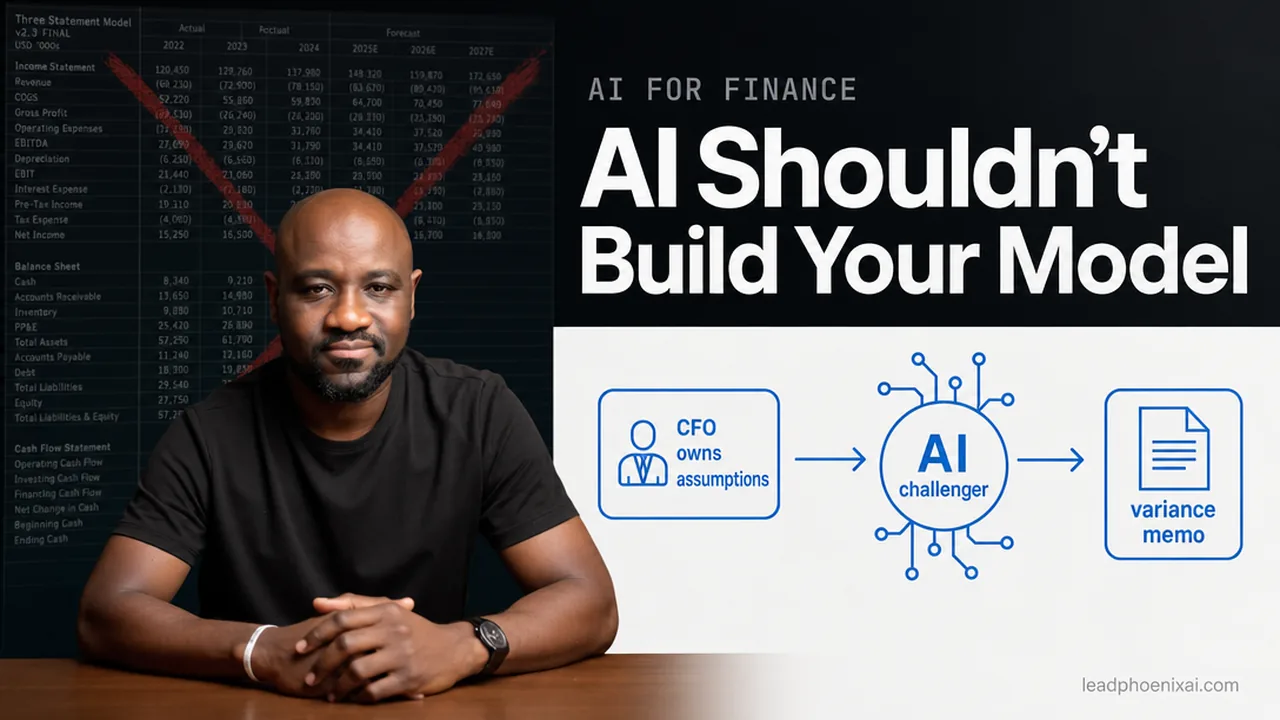
The prevailing wisdom on AI and financial modeling goes like this: describe the model structure, let AI build it in 30 seconds, adjust the assumptions, move to analysis. AI drafts, human finishes.
Here's why that's the wrong workflow entirely.
What 300 CFOs Watched Happen
Ian Schnoor of the Financial Modeling Institute ran a live test of Microsoft Copilot in front of nearly 300 CFOs. Copilot produced a three-scenario model. Best case: base outputs multiplied by 1.35. Worst case: base outputs multiplied by 0.65. All of it hardcoded directly into output cells, with no connected assumption page and no scenario switch. Change one input and none of the scenarios update.
The balance sheet was off too. Copilot grew "other long-term assets" over time with no corresponding cash outflow on the cash flow statement. Assets increased. Nothing offset them.
The model looked finished. It wasn't.
That's the problem in one sentence, and CFO Connect's report on the test named it directly: "The problem is not that AI gets it wrong. The problem is that AI gets it wrong confidently."
A human-built model has weak spots the builder knows about. An AI-generated model has weak spots distributed across the whole thing, in places you're not accustomed to checking, presented with the same formatting confidence as the parts that are correct.
Why the Workflow Is Backwards
The 'AI drafts, human finishes' loop assumes the AI's assumptions are close enough to correct that adjustment is minor. They usually aren't.
AI-generated models embed generic, cross-firm assumptions. They don't know your COGS curve. They don't know that Q3 always softens because of a specific channel dynamic. They don't know your customer concentration or your renewal seasonality. Tyler Grube, CFA at Sapling Financial Consultants, put it plainly: in some cases, it's faster to build a clean model from scratch than to fix a flawed AI-generated one.
So you end up spending more time correcting a draft than building would have taken. And the output you're correcting is one where the errors are hidden in non-obvious places, not in the cells you'd naturally check first.
That's not a productivity gain. That's a productivity loss with extra steps and a false sense of confidence.
What Boards Actually Want
Speed of model construction is not the deliverable boards care about, and most AI-for-finance content misses that.
Cosmin Pitigoi, CFO of Flywire, said it directly: "The issue has always been the model's ability to explain the assumptions behind the forecast." Not the speed of generating the forecast. The explainability of the assumptions.
Only 42% of organizations rate their forecasts as "great or good," according to the FP&A Trends Survey. If AI is accelerating the existing workflow and forecast quality is still that low, the workflow shape is the problem — not the speed.
What boards want is a variance narrative. Where was the model wrong last quarter? By how much? What's changing in the assumptions going into next quarter, and why? That's the conversation that builds credibility in the boardroom. A faster forecast that's wrong in the same ways as last quarter's forecast doesn't help anyone.
The Workflow That Actually Works
The CFOs getting real value from AI in modeling have flipped the sequence.
They own the assumptions. Every assumption is intentional, documented, and connected to a real business dynamic the CFO understands. The model is built by someone who knows where the weak spots are.
Then they use AI to challenge those assumptions against realized data. Eight to twelve quarters of actuals. The AI's job isn't to generate the model. It's to surface where the model has been wrong, by how much, and whether the pattern is systematic or noise.
The output is a memo. "Here's where our model has consistently over-estimated revenue. Here's the quarter where the gap was largest and what drove it. Here's what we're adjusting in the assumption going forward and why." That memo is grounded in the firm's own numbers, not industry averages. It's explainable to an audit committee. It's board-ready.
That's the deliverable. Not a faster first draft.
IMD Business School describes this direction well: rather than producing static forecasts, the most effective AI implementations "continuously integrate financial, operational, and external data to test assumptions and update projections in near real time." The AI interrogates the model dynamically. The CFO owns the model.
What You Lose When You Outsource the Build
There's a second-order cost to the wrong workflow that doesn't show up in the immediate output quality.
Building a model is where assumption quality gets forged. When a finance team works through the model together, debating whether to use a 3% or 5% churn assumption, arguing about whether to model the new product line separately, those conversations sharpen the team's understanding of the business. They surface blind spots. They build stakeholder alignment before the forecast ever reaches the board.
When you outsource the build to AI, you skip those conversations. The model arrives looking finished. Nobody argued about the assumptions because nobody built them. And when the board asks "why did you use this growth rate?" the honest answer is "the AI picked it."
That's not a position any CFO wants to be in.
The Adoption Gap Tells You Something
The 2026 State of AI in Finance report found that 56% of finance leaders now use AI — double the adoption rate from 2023. But only 17% are using it in core workflows. Finance ranks last among all business functions for AI deployment. Forty-five percent of teams are still in limited pilot mode.
That gap isn't because CFOs are slow. It's because the workflow being sold to them — AI drafts, human finishes — doesn't actually solve the problem they have. The problem isn't speed of model construction. It's assumption quality and forecast explainability. And the draft-first workflow doesn't touch either of those.
The teams that have scaled AI in finance report 41% satisfaction with outcomes, versus 25% for teams still in pilot mode. But only 15-25% of CFOs have fully scaled. The ones who have scaled are, in most cases, the ones who figured out that AI works better as a challenger than as a builder.
The Mental Model to Carry Forward
Stop thinking of AI as a model builder. Start thinking of it as a model challenger.
You own the assumptions. You build the model or your team does. You know where the weak spots are because you put them there intentionally. Then you point AI at your own historical data and ask it to tell you where you've been wrong, how often, and by how much.
The output you bring to the board isn't a faster forecast. It's a documented, explainable account of your model's track record and what you're changing based on it. That's the conversation that builds credibility. That's the deliverable that survives an audit committee question.
AI drafts, human finishes is the wrong shape. Human owns, AI challenges is the right one.
If you want to see what this looks like in practice for a mid-market finance team, including what the data infrastructure requires, which workflows to sequence first, and how to scope it in a way that produces a board-ready output within 90 days, that's exactly what our AI Readiness Audit is designed to surface.
Frequently Asked Questions
Doesn't AI save time even if the assumptions need adjustment? Isn't some time saving better than none?
Only if the adjustment time is genuinely minor. The live test evidence and practitioner feedback suggest it often isn't — in some cases, fixing a flawed AI-generated model takes longer than building from scratch. The time saving is real when AI is handling data aggregation and formatting; it disappears when the CFO has to reverse-engineer and rebuild the assumption logic.
What does 'owning the assumptions' actually mean in practice?
It means every assumption in the model is documented, connected to a real business dynamic, and defensible in a board conversation. The growth rate isn't a number the AI picked from industry benchmarks — it's a number the CFO chose based on specific knowledge of the business, with a documented rationale. When the board asks why, there's an answer that doesn't involve the word "algorithm."
How many quarters of actuals does a mid-market CFO need before AI can meaningfully challenge the model?
Eight to twelve quarters gives the AI enough pattern data to distinguish systematic model bias from noise. Fewer quarters are still useful for directional analysis, but the confidence in the output is lower. The minimum viable starting point is whatever historical data currently lives in your ERP or FP&A tool — the infrastructure question is whether it's clean and connected enough to query.
Is the challenger workflow meaningfully different from what FP&A teams already do in variance analysis?
The underlying logic is the same — compare actuals to forecast, identify the gap, explain it. What changes is speed and pattern detection at scale. A manual variance analysis covers the last quarter. An AI-assisted challenger workflow can surface patterns across 10 quarters simultaneously, flag whether a specific assumption category has been systematically wrong, and do it in the time it used to take to pull the data. The insight is the same; the throughput is different.
Which AI tools are positioned as model challengers rather than model builders?
Most current FP&A AI tools are still positioned as draft generators or automation layers. The challenger framing is emerging in governance practice — some teams are building champion-challenger model governance into their AI frameworks, requiring every model to carry lineage, versioning, and audit trails with challenger models running in parallel. But it's not yet a standard product category. For most mid-market finance teams, the challenger workflow is built through configuration of existing tools against your own data, not by buying a new platform.
Sources
Cited inline above:
- CFO University / Financial Modeling Institute — CFO Connect Live Test: Microsoft Copilot Financial Modeling
- CFO University — CFO Connect AI Modeling Test Report
- Sapling Financial Consultants — AI Financial Modeling Practitioner Review
- FP&A Trends Survey — Forecast Quality Benchmarks
- State of AI in Finance — 2026 State of AI in Finance Report
Additional sources consulted for this piece:
- Breaking Into Wall Street — 2026 AI Financial Modeling Tool Ranking
- FinModeler.com — AI Financial Modeling Practitioner Advisory
- Sourcetable — AI Financial Modeling Guide (May 2026)
- Limelight — Explainable AI Guide for Finance
- IMD Business School — CFO and AI: 2026 Outlook
- Bain & Company — CFO AI Deployment Report (April 2026)
- Acterys — FP&A Forecasting Guide (March 2026)
- Flywire — CFO Insights: Cosmin Pitigoi
- EverWorker — AI Governance Framework (March 2026)
- FrontierFinance / arXiv — AI Financial Modeling Benchmark Study (April 2026)
- Bloomberg Intelligence — AI in Finance: Brian Egger
- Bain Capital Ventures — CFO Advisory Council (February 2025)