The Law Firm Partner Dashboard That Doesn't Exist Yet
Most law firm managing partners are making compensation and staffing decisions on data that's 30–45 days old, pulled from three systems that have never talked to each other. Here's what the workflow looks like now, what it should look like, and how to close the gap.
A billing partner gets a call from a client asking about their budget status.
The partner doesn't know. So they call their assistant, who calls the finance team, who asks the associates to enter their time so they can run a report.
That process takes days. By the time the answer arrives, the matter has already blown past budget. The write-off is baked in before anyone even knew there was a problem.
This isn't a horror story. This is Tuesday at most mid-size law firms.
And it's the reason I keep saying that the law firm partner intelligence gap is the most underserved operational problem in the $20M–$150M firm market right now. Everyone's talking about Harvey and AI-assisted document drafting. Nobody's talking about the fact that your managing partner is making compensation, staffing, and origination decisions on 30-to-45-day-old data pulled manually from three systems that have never been connected.
Let's walk through what the workflow actually looks like today, what it should look like, and what it takes to get there.
How Most Month-Ends Actually Work
Here's the current state at a typical mid-size firm.
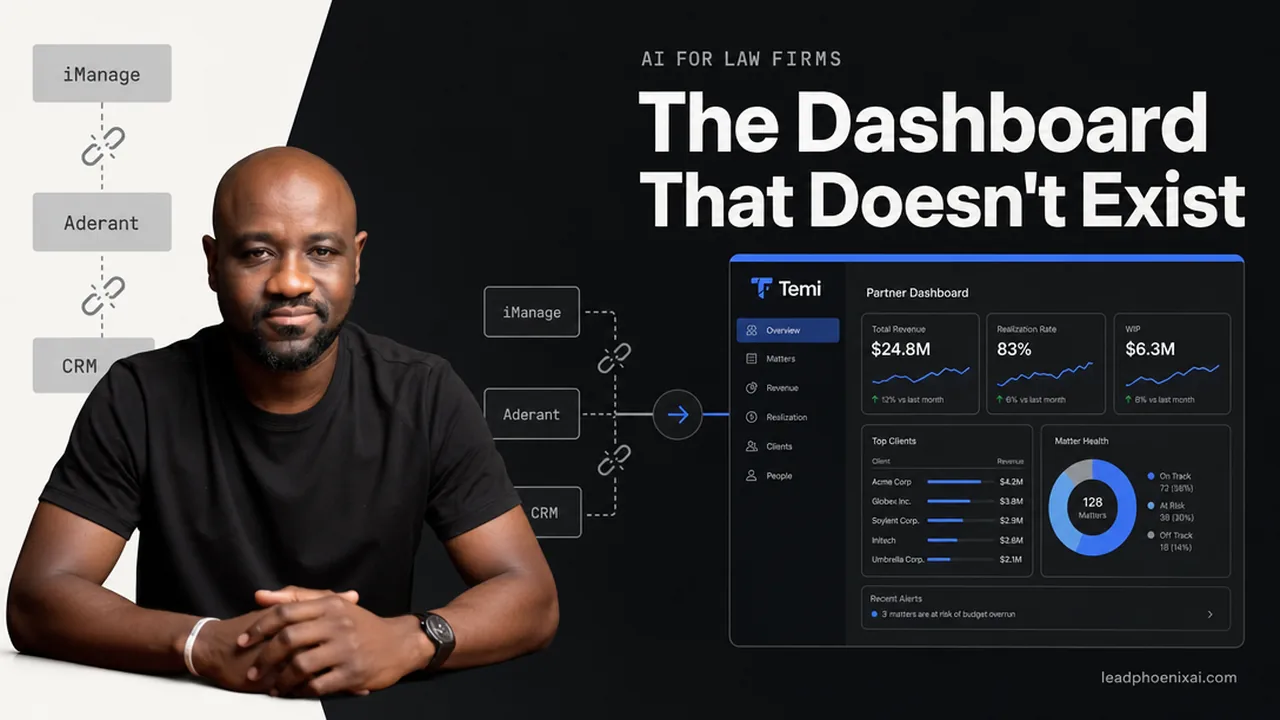
Your billing data lives in Aderant or Elite 3E. Your matter activity (documents opened, versions created, who's working on what) lives in iManage. Your client relationship history, origination credits, and business development pipeline lives in a CRM, or more likely in a partner's inbox and a spreadsheet someone updates quarterly.
None of these talk to each other.
So at month-end, your controller pulls billing data from Aderant into Excel. Someone else pulls utilization numbers. A third person assembles the partner report. That report lands in partners' inboxes 10 to 15 days after month-end as a PDF listing hours billed, realization rate, and collected revenue. There's no way to drill down, no matter-level view, and no early warning on anything.
The managing partner looks at it, flags two or three things to follow up on, and files it away. By the time they act on anything in that report, the underlying situation has moved on.
The industry numbers back this up. The average law firm total lockup — WIP plus AR — is 93 days. The average realization rate is 88%. And the part that should bother every managing partner is that realization loss doesn't happen in one big event. It accumulates through dozens of small ones: hours that never get entered, courtesy discounts added during bill review, scope creep that nobody reset expectations on. By the time it shows up in the monthly PDF, it's already history.
Meredith Williams-Range, the Chief Legal Operations Officer at Gibson Dunn, put it plainly: "Your firm can invest in the best GenAI tools ever imagined. But it must run on good, clean data in order for everything else to work."
That's the problem. The data exists. It's just not clean, and it's not connected.
What the Existing Tools Actually Do (And Don't Do)
Before I describe what we build, it's worth being honest about what's already on the market.
There are legal BI tools — BigHand/Iridium, LexInsight, Coyote Analytics — that do real work. They connect to your PMS and give you better reporting than a monthly Excel export. LexInsight claims to reduce revenue visibility lag from 30–45 days to under 10–14 days. That's a genuine improvement.
But every one of these tools has the same structural limit: they connect to a single PMS. They read Aderant or Elite 3E. They don't bridge iManage, where your matter activity signals actually live. They don't connect to your CRM, where origination and client relationship data sits. So you get better financial reporting on top of the same silo.
Aderant just launched Stridyn, their AI-driven cloud platform, with analytics built in. Thomson Reuters has been building AI into Elite 3E since the TPG acquisition. These are real investments. But they're AI built on top of Aderant's data, or Thomson Reuters' data, not a unified layer across all three systems. The cross-system query problem is still unsolved.
Nicholas d'Adhemar, the founder of Apperio, made a point that stuck with me: most legal spend tools are built for client-versus-firm dynamics, not for the managing partner's internal operational intelligence need. They weaponize data and play one side against the other. That's not what a managing partner needs. They need to see their own firm clearly.
Here's What Changes
The architecture shift is straightforward to describe, even if the plumbing takes work.
You connect Aderant or Elite 3E, iManage, and your CRM into one unified data layer. Not a new system on top, but a layer that reads from all three and makes them queryable together. Then you build a partner dashboard that updates daily, not monthly. And you deploy a matter intelligence agent that monitors for anomalies and flags them before they become write-offs.
Here's what that actually unlocks.
Instead of a monthly PDF, the managing partner opens a dashboard that shows, right now: which matters have realization below 80% this month? Which partners have capacity? Which clients haven't had a meaningful touch in 60 days but have open matters?
And instead of finding out about a blown budget when the client calls, the agent flags it. A matter where hours are accelerating but no billing has gone out in three weeks is a flag. A matter where the same partner's hours spiked 40% last week but realization on that client has been trending down for two months is another flag. The agent surfaces it. A human reviews it. The managing partner decides what to do.
That's the shift: from periodic reporting (monthly PDF, backward-looking) to continuous intelligence (daily dashboard, anomaly-flagged, forward-leaning). The managing partner stops managing by looking in the rearview mirror and starts managing by exception, only seeing what needs attention.
The ROI math is not complicated. A 1-point improvement in realization on $2M in annual billings is $20,000 in pure profit. At a $50M firm, a 1-point improvement across the book is $500,000. At $500–$800 per hour partner rates, a single matter caught before it blows past budget can pay for months of the infrastructure that caught it.
The Query They've Never Been Able to Ask
The moment that lands in every conversation I have with managing partners is when I describe the query.
Not a dashboard feature. Not a report. A question the firm has never been able to ask because the data to answer it has never been in one place.
"Show me every matter where partner hours spiked in the last 30 days but realization dropped."
"Show me every client where revenue grew year-over-year but our hours dropped — that's where we're under-billing."
"Show me every prospect who hasn't heard from us in 90 days but had three matters close in the last year."
None of these are hard questions. They're obvious questions. But they're unanswerable when your billing system, your matter management system, and your CRM have never been connected. The value isn't in the AI layer. The value is in the correlation across silos that the AI layer makes possible.
This is the same architecture we've deployed for CPA firms, connecting Karbon, Sage Intacct, and the CRM into one source of truth, then running queries that surface advisory opportunities the firm was sitting on without knowing it. The connectors are different (iManage instead of Karbon, Aderant instead of Sage Intacct), but the pattern is identical.
One Honest Caveat
I want to name something that the Bloomberg Law reporting flagged, because I think it matters.
Optimizing purely for realization metrics can damage client relationships. Partners who feel measured only on billing efficiency start making decisions that protect the number at the expense of the relationship. A dashboard that only surfaces financial signals can make decisions worse, not better, if it's the only signal the managing partner sees.
The right answer isn't to avoid the dashboard. It's to build relationship health signals into it alongside the financial ones — client tenure, matter repeat rate, engagement frequency. The goal isn't to squeeze every dollar out of every matter. It's to give the managing partner a complete picture so they can make better decisions. That's a design choice, and it's one we make deliberately in every engagement.
How to Roll This Out
You don't need to solve the entire data architecture before you start.
The first move is to pick the most painful question the managing partner can't currently answer and identify which two systems hold the data to answer it. Usually that's Aderant and iManage, the billing system and the matter activity system. Connect those two first. Build one query. Show the managing partner something they've never seen before.
That first query is what earns the conversation about the broader infrastructure. It's also what earns the trust of the partners who are skeptical that any of this is real.
From there, you add the CRM layer. You build the anomaly detection. You configure the dashboard. You do it in sprints, measuring the output of each sprint against a specific KPI — realization rate, matter write-off rate, partner capacity utilization — not against a transformation roadmap.
The firms that get this right don't announce an AI transformation. They just start answering questions they couldn't answer before. And then they can't imagine going back.
If you want to know where your firm sits on this — which systems are connected, which queries are possible today, and where the highest-ROI gaps are — that's exactly what our AI Readiness Audit is designed to surface. Two weeks, a written report, and a 90-day roadmap. Most managing partners walk away with three or four questions they've never been able to ask, and a clear picture of what it would take to answer them.
Frequently Asked Questions
Does this require replacing our existing billing system or practice management software? No. The source-of-truth layer reads from your existing systems — Aderant, Elite 3E, iManage, your CRM — without replacing any of them. Your systems of record stay exactly where they are. We connect them into a unified layer on top, so you can query across all of them without changing how your team enters data today.
How long does it take to see the first useful output? For most mid-size firms, the first cross-system query is running within two to three weeks of starting the data connection work. That's not the full dashboard — that's the first question the managing partner has never been able to ask, answered with live data. The full partner intelligence layer typically takes six to eight weeks to configure and validate.
We already have a BI tool connected to our PMS. Why isn't that enough? Most legal BI tools — Iridium, LexInsight, Coyote Analytics — connect to one system, usually your PMS. They give you better reporting on your billing data. What they don't do is bridge your matter activity data from iManage and your client relationship data from your CRM into the same queryable layer. The queries that surface real operational intelligence — which matters are at risk, which clients are under-served, which partners have capacity — require all three systems connected. A single-PMS BI tool can't answer those questions.
What does the anomaly detection actually flag? The most common flags we configure are: matters where hours are accelerating but no billing has gone out in more than two weeks; matters where realization has dropped more than 10 points in 30 days; partners whose utilization has been below target for three consecutive weeks; and clients who have open matters but haven't had a meaningful communication touch in 60 days. Every flag goes to a human reviewer before any action is taken — the agent surfaces the anomaly, the managing partner decides what to do with it.
How do you handle the sensitivity of partner compensation and billing data? Every build starts with a governance conversation: who has access to what, what gets logged, and where the human approval seam sits. Partner-level financial data is role-gated — the managing partner sees everything, individual partners see their own data and their matters, associates see only what's relevant to their work. Nothing writes back to your systems of record without explicit approval. The audit trail is built in from day one, not added later.
Sources
Cited inline above:
- Apperio — Law firm billing partner budget call scenario
- Gibson Dunn & Crutcher / Meredith Williams-Range — GenAI and data foundation quote
- Apperio / Nicholas d'Adhemar — Legal spend tools and adversarial dynamics
- Bloomberg Law — Realization metrics and client relationship tension, August 2025
- Bloomberg Law — Leading Law Firms AI adoption survey, 2025
Additional sources consulted for this piece:
- Claude web research synthesis — Law firm realization rate and lockup benchmarks, 2025
- Claude web research synthesis — Attorney utilization rate and billable hour capture data
- Claude web research synthesis — Aderant Stridyn platform launch details
- Claude web research synthesis — LexInsight / Addenda Analytics revenue visibility claims
- Claude web research synthesis — BigHand Business Intelligence / Iridium product description
- Claude web research synthesis — Thomson Reuters Elite 3E and TPG acquisition AI development
- Claude web research synthesis — BA Insight enterprise system connectors
- Claude web research synthesis — Enterprise AI data foundation readiness statistics