The CFO's AI Implementation Guide: Governance First
Most CFOs find out they have an AI governance problem the same way — their auditor asks a question they can't answer. Here's the implementation framework that fixes it before that conversation happens.
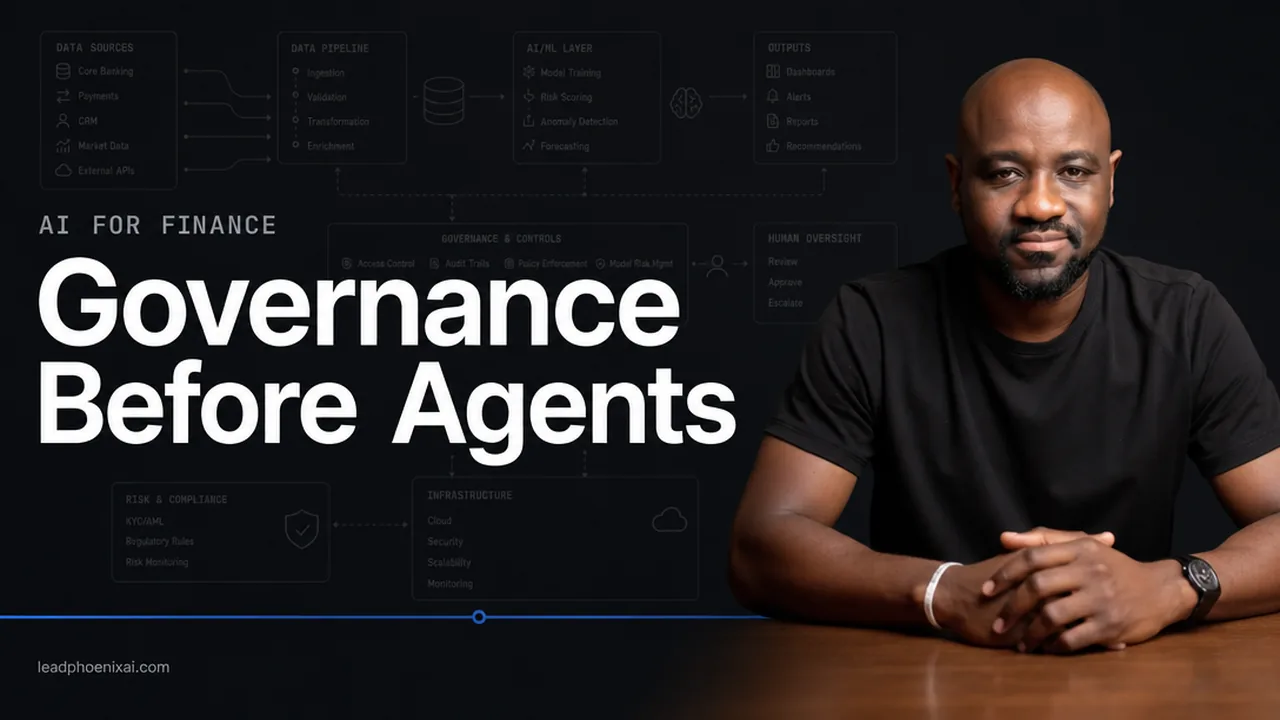
Your CFO finds six figures of AI subscriptions scattered across the organization. Nobody owns it, there's no audit trail, and nobody can tell her what any of it is actually doing with your client data.
That's not a hypothetical. Josef Holm described it on X as the canonical trigger for the fractional CAIO search: "Most CEOs don't go looking for a Fractional CAIO. They get handed the search by their CFO, who found six figures of AI subscriptions sitting across the org with no owner."
The CFO is usually the one who finds the problem. And she's right to be alarmed.
AI implementation for CFOs isn't primarily a technology question. It's a governance question. And most mid-market firms are getting the sequence exactly backwards.
The Governance Gap Is Already Being Exploited
The data is stark.
IBM's 2025 Cost of a Data Breach report found that 13% of organizations reported breaches of AI models or applications. Of those, 97% lacked proper AI access controls. One in five organizations reported a breach directly attributable to shadow AI. And those shadow AI breaches added $670,000 to average breach costs compared to organizations with low or no shadow AI.
Suja Viswesan, VP Security and Runtime Products at IBM, put it plainly: "The data shows that a gap between AI adoption and oversight already exists, and threat actors are starting to exploit it."
That $670,000 figure isn't a technology cost. It lands on the CFO's desk.
And it's not just breach risk. Deloitte found that only 21% of enterprises have a mature model for agent governance, meaning roughly 80% lack clear agent decision boundaries, real-time monitoring, and audit trails. Your finance team is almost certainly in that 80%.
Why Most AI Deployments Fail Before They Start
I see the same pattern in almost every mid-market engagement.
The firm buys some AI tooling. A few people start using it. Someone builds a workflow. Nobody connects it to the actual systems of record. The data feeding the agent is stale, siloed, or wrong. The outputs are unreliable. The CFO stops trusting it. The whole thing quietly dies.
BCG's 2026 CFO AI Agenda report names this precisely: "Automating a fragmented process scales fragmentation rather than eliminating it."
That's the whole problem in one sentence. You're not fixing the underlying issue by adding AI on top of it. You're just making the broken output arrive faster.
The firms that get real ROI from AI don't start with the agent. They start with the data. Before any workflow automation, all of the company's systems (your ERP, your CRM, your document management, your project tools) need to stop being siloed and connect to one unified source of truth. That's not glamorous work. It doesn't look like transformation from the outside. But it's the foundation everything else runs on.
Without it, every agent you build is only as smart as the one silo it can see.
What Governance Actually Looks Like in Practice
I want to be specific here, because "governance" gets used as a catch-all that means nothing.
For a CFO deploying AI into financial workflows, governance means five concrete things.
First: agents draft, humans approve. The deliverable is never "AI runs your finance function." It's "AI prepares the first 85%, you spend your time on judgment." Every output is a draft with a review step. That seam — where the human signs off — needs to be visible in the interface, not buried in a policy document.
Second: source citations on every number. Every claim the agent makes links back to the source row, file, or system it pulled from. If the agent can't show its work, the CFO won't trust it. This is the single biggest trust unlock I've seen in practice. It's also what separates a useful finance agent from a hallucination engine.
Third: a full audit trail. Who ran it, when, with what inputs, what was approved, what was overridden. Standard logging. Not glamorous, but every regulated finance team will ask for it, and FINRA's position is unambiguous on this point.
FINRA's 2026 Annual Regulatory Oversight Report states that existing supervision, recordkeeping, and fair-dealing rules apply to GenAI and agentic systems. The expectation is "reasonably designed" supervisory controls, including human oversight and audit logs. The rules are technology-neutral. Using an AI agent doesn't exempt you from the obligations that already exist.
Fourth: read from source, don't replace it. The GL, the CRM, the policy admin system stays the system of record. The agent reads, normalizes, and drafts. It doesn't write back to the system of record without explicit sign-off. This is a non-negotiable architectural decision, not a nice-to-have.
Fifth: confidence thresholds and abstention. When the agent isn't sure, it says so. A finance agent that confidently produces a wrong number is worse than one that says "I don't have enough data to answer this reliably." Build the abstention behavior in from the start.
The Walmart Lesson for Mid-Market Finance Teams
Walmart built four super agents (Sparky for customers, Marty for partners, an Associate Agent for employees, and WIBEY for developers) on top of its Element ML platform, which was refactored specifically to orchestrate agents.
Suresh Kumar, Walmart's CTO, explained the consolidation rationale: "Having a plethora of different agents can very quickly become confusing." So they built a control layer that sits above the agents and manages orchestration, access, and scope.
Sravana Karnati, EVP Global Platforms at Walmart, described the core governance principle: "There needs to be a way of figuring out that the agent is actually doing what it's doing, and nothing more."
That's the principle. Not "can the agent do more?" but "is it doing exactly what it's supposed to, and nothing beyond that?"
You don't need Walmart's infrastructure to apply that principle. You need scope discipline. A small, well-defined agent is auditable. A sprawling one isn't. Every agent deployment should have a clear answer to: what is this agent allowed to do, what data can it access, and what requires human approval before execution?
The Right Implementation Sequence
For a mid-market CFO who wants to deploy AI without creating a governance liability, I'd sequence it this way.
Step one: build the source-of-truth layer first. Connect your existing systems into one unified data layer before you automate anything. This is the infrastructure decision that determines whether your agents produce reliable output or confident nonsense.
Step two: pick one painful, measurable KPI. Don't try to transform the whole finance function at once. Pick the process that's most painful and most measurable: AR follow-up, monthly close, variance reporting, whatever is eating the most senior time for the least strategic return. Scope the first agent around that one outcome.
Step three: build the control layer into the first sprint, not the last. Audit trail, source citations, human approval step, confidence thresholds. These aren't features you add after the agent is working. They're the features that make the agent trustworthy enough to actually use.
Step four: measure the lift, then expand. What changed? How many hours did it free? What did those hours go toward? If you can't answer those questions after 30 days, the implementation isn't done — it's just running.
The implementations that work are the ones where the CFO can point to a specific process that no longer requires a human to initiate it, and a specific outcome that improved as a result. That's not transformation as a program. That's transformation as a result.
Frequently Asked Questions
What's the difference between shadow AI and sanctioned AI deployment, and why does it matter for CFOs? Shadow AI refers to AI tools being used by employees without IT or leadership approval, like individual ChatGPT accounts, browser plugins, or unauthorized SaaS subscriptions that touch company data. IBM's 2025 breach data found that 20% of organizations suffered a breach directly attributable to shadow AI, adding $670,000 to average breach costs. For CFOs, the risk is both financial and regulatory: data leaving the organization through unsanctioned tools may violate client confidentiality, recordkeeping obligations, or data residency requirements. The fix isn't banning AI. It's creating a sanctioned path that's easier to use than the unsanctioned one.
Do existing compliance rules actually apply to AI agents, or is this a regulatory gray area? FINRA's 2026 Annual Regulatory Oversight Report is explicit: existing supervision, recordkeeping, and fair-dealing rules apply to GenAI and agentic systems. The rules are technology-neutral. If your firm is in a regulated industry, using an AI agent to prepare a client communication or process a financial transaction doesn't create a new compliance framework — it triggers the one you already operate under. "Reasonably designed" supervisory controls, including human oversight and audit logs, are the expectation.
What does a 'source-of-truth layer' actually mean in a mid-market finance context? It means connecting your ERP, CRM, document management, and communication tools into one unified data layer that every agent, report, and workflow pulls from. Right now, most mid-market finance teams have their data spread across systems that don't talk to each other, which means any AI you deploy can only see one silo at a time. The source-of-truth layer is what makes cross-system queries possible: "show me every client where revenue grew but our hours dropped" or "show me every project where the same variance category appeared three months running." Without it, you're not getting intelligence. You're getting faster spreadsheets.
Why should AI agents suggest and approve rather than act autonomously in financial workflows? Because current AI gets you to roughly 80-85% of output quality reliably, and the remaining 15-20% is where judgment, context, and accountability matter most. In financial workflows like client billing, variance reporting, AR follow-up, and regulatory filings, the cost of a confident wrong answer is higher than the cost of a human review step. The suggest-and-approve model isn't a limitation; it's the right design. The agent handles volume, speed, and consistency. The human handles the final call on anything that carries financial or reputational weight. Together they produce better output than either would alone.
How do I know if my firm is ready to deploy AI agents in finance, or if we need to fix the data layer first? Ask one question: can you currently run a single query that pulls from your ERP, your CRM, and your project management tool at the same time? If the answer is no, if answering a question like "which clients are most at risk of churn based on billing delays and open issues?" requires someone to manually pull from three systems and build a spreadsheet, your data layer isn't ready for agents yet. The agent will be only as smart as the one system it can see. Fix the data plumbing first, then deploy the automation on top of connected, reliable data.
Sources
Cited inline above:
- IBM Newsroom — IBM Report: 13% of Organizations Reported Breaches of AI Models or Applications, 97% of Which Reported Lacking Proper AI Access Controls
- Deloitte — Agentic AI Is Scaling Faster Than Guardrails
- FINRA — 2026 Annual Regulatory Oversight Report: Generative AI
- Josef Holm (@JosefHolm) — X/Twitter post on CFO-triggered CAIO searches
- BCG — The CFO's AI Agenda: From Automation to Advantage (2026)
Additional sources consulted for this piece:
- VentureBeat — IBM: Shadow AI Breaches Cost $670K More, 97% of Firms Lack Controls
- Network World — IBM Cost of U.S. Data Breaches Reaches All-Time High and Shadow AI Isn't Helping
- Jones Walker AI Law Blog — The AI Oversight Gap: IBM's 2025 Data Breach Report Reveals Hidden Costs of Ungoverned AI
- Walmart Global Tech — All In on Agents
- SiliconAngle — Walmart Embraces Agentic AI with Major ML Platform Upgrade and Developer Super Agent
- IT Brew — Inside Walmart's AI Strategy
- DLA Piper — FINRA Flags Generative AI Risks and Governance Expectations
- Workiva — 2026 Executive Benchmark Survey: Instability Accelerating Data Automation
- Deloitte — Multi-Agent AI in Sourcing and Procurement
- Baker Donelson — Summary of IBM 2025 Cost of a Data Breach Report
- Okta — How to Implement Least Privilege for AI Agents