Your AI Agents Are Consistent. Your Workflow Design Is Still Broken.
Most mid-market firms drop an agent into an unchanged process and call it transformation. They get speed inside a broken design. Here's what workflow redesign actually looks like — and why it's the only place AI ROI lives.
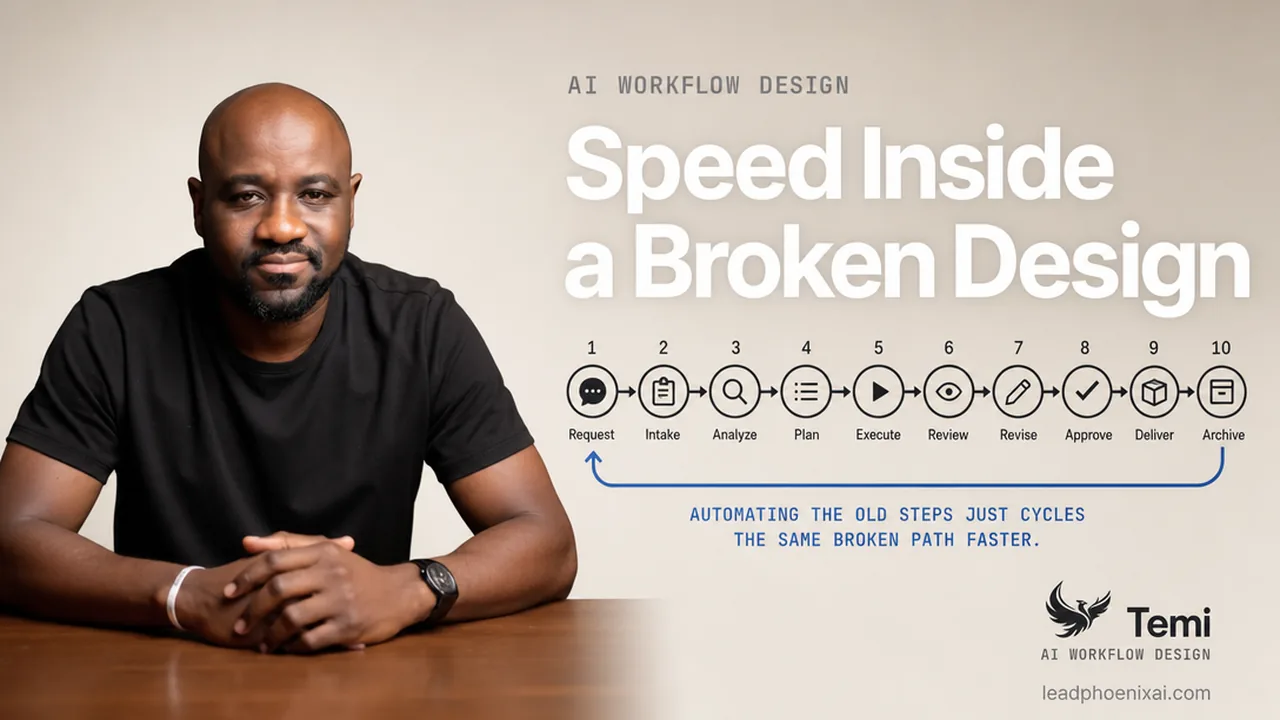
Your AI agents are consistent. That's the problem.
You deployed an agent on your month-end close. It executes every step faster. The close still takes 10 steps. The variance report still goes to the wrong person — it just arrives sooner. Six months later, you're reporting "efficiency gains" to the board while the underlying bottlenecks, approval chains, and handoff failures are now locked in and automated.
Bain calls this "workflow debt." Finance teams running AI-generated forecasts alongside existing bottom-up planning cycles — two processes in parallel, neither fully trusted, with the expected benefits largely unrealized. The AI was deployed. The work wasn't redesigned.
This is the most common failure pattern in mid-market AI right now. And almost nobody names it clearly.
The Vendor Story Is Wrong
Every enterprise AI vendor is selling the same thing: automation speed as the transformation outcome. Automate your reconciliations. Automate your close checklist. Automate your variance reports. They'll happen faster, with less headcount, and your team can focus on higher-value work.
It sounds right. It isn't.
When you automate an old process, you preserve every assumption baked into that process. Every bottleneck. Every unnecessary handoff. Every approval step that exists because someone didn't trust someone else five years ago. You get speed inside a broken operating model. The work moves faster. The operating model hasn't changed.
There's a principle that's been true in industrial engineering for 30 years: never automate a bad process. By automating a bad process, you only speed up bad results. That principle predates AI by decades. The fact that we're still violating it in 2026, at scale, with expensive tooling, says something about how good the vendor pitch is.
What the Data Actually Shows
McKinsey's April 2026 research found that fewer than 40% of companies investing in AI report meaningful bottom-line impact. Almost all of them (90%) are investing. Fewer than half are seeing it move the P&L.
The same research found that AI high performers are 3x more likely to have redesigned workflows end-to-end. Only 21% of all companies do this.
That gap, between the 90% investing and the 40% seeing impact, is almost entirely a workflow design gap. It isn't about model quality or tooling. It's about design.
Basware's 2026 CFO survey found that 61% of finance leaders admit their organizations have rolled out AI largely as experiments to test capabilities rather than to solve real business problems. That's not a technology problem. That's a scoping problem. They deployed before they redesigned.
The ServiceNow Counter-Argument (And Why It's Wrong)
There's one vendor that argues the opposite. ServiceNow's position is essentially: go ahead and automate the bad process. AI will surface the dysfunction and force redesign through visibility. Automate first, let the pain of bad output drive the fix.
I understand the logic. I think it's wrong for most mid-market firms.
Here's why. When you automate a broken process, you do two things simultaneously. You make the broken output arrive faster, which creates pressure to fix it. But you also lock in the assumptions of the old process in code, in integrations, in the agent's training data, in the approval workflows your team has now built around the automated version. Those assumptions get harder to dislodge, not easier, once they're automated.
Enterprises with large IT teams and high change-tolerance can absorb that failure cost. A $40M professional services firm cannot. One bad automated output that goes to a client, or one reconciliation that runs wrong for three months before anyone catches it, is a trust problem that takes a year to recover from.
For mid-market, the redesign-first approach isn't just better. It's the only one that's survivable.
What Workflow Redesign Actually Means
Most firms never ask the real question: what would this process look like if an agent could monitor, retrieve, draft, reconcile, and escalate continuously, without being asked each time?
That question is different from "which manual step can AI do faster?" It starts from the outcome, not the task. And it forces you to decide where the human actually belongs.
The human should appear where judgment matters, where client sensitivity is high, and where someone has to be accountable. Not at every old step just because the old workflow required it.
Take a standard AR follow-up process. The old workflow: someone pulls an aging report, identifies overdue accounts, drafts follow-up emails, gets them reviewed, sends them, logs the activity. Every step is manual. Every step requires a human to initiate it.
The redesigned workflow: an agent monitors the AR aging continuously. When an account crosses a threshold, it drafts a follow-up, checks the client relationship history, flags any open disputes, and puts a review-and-approve task in front of the right person. The human reviews in 90 seconds and approves. The agent logs and sends.
The human didn't disappear. The human's judgment is still in the loop. But the human is now doing the 10% of the work that actually requires them — not the 90% that was just process execution.
That's not automation. That's workflow redesign.
McKinsey's analogy for this is the electric motor replacing the steam engine. Most factories in the early 20th century just swapped the power source and kept the same factory layout. The breakthrough came later, when companies redesigned their factories around electricity — new layouts, new operating models, new ways of organizing work. The companies that just swapped the motor got incremental gains. The companies that redesigned got a different business.
We're in the same moment with AI. Most firms are swapping the motor.
The Practical Starting Point
You don't need to redesign everything before you start. You need to redesign one process before you automate it.
Pick the process that is most painful and most repetitive. Map it as it actually runs today — not as the procedure manual says it runs, but as it actually runs. Find the steps where a human is doing work that doesn't require a human. Find the handoffs that exist because of distrust, not because of genuine judgment requirements. Find the approval steps that are rubber stamps.
Then ask: if an agent owned the monitoring, the retrieval, and the first draft — where does the human actually need to be?
Build that version. Not the automated version of the old process. The redesigned version.
The firms that are actually capturing ROI from finance AI right now — HPE scaling agentic AI across credit, collections, accounts payable, and receivable; Alphabet automating invoice payment and reconciliation workflows — aren't running faster versions of their old processes. They redesigned the workflows first.
The companies that standardized their data and processes before deploying agents achieved full workflow automation in six months. Those with fragmented environments required 12 to 18 months. The redesign work isn't a delay. It's what makes the deployment stick.
The Question That Changes Everything
Stop asking: which manual step can AI do faster?
Start asking: what should this process become now that an agent can own part of it continuously?
The first question gets you speed inside your current design. The second question gets you a different operating model.
That's where the ROI lives. Not in the automation. In the redesign.
If you want to know which of your current workflows are worth redesigning versus which ones just need better tooling, that's exactly what our AI Readiness Audit is built to surface. In two weeks, working from your actual stack, you get a ranked list of the highest-leverage redesign opportunities and a 90-day roadmap to act on them.
Frequently Asked Questions
Do I need to redesign every workflow before deploying any AI agents? No. You need to redesign one workflow before you automate it — not all of them upfront. Pick the process that is most painful and most repetitive, map how it actually runs today, identify where a human is doing work that doesn't require human judgment, and build the redesigned version of that process first. One well-designed workflow produces more ROI than five automated versions of broken ones.
What's the difference between automating a workflow and redesigning it? Automation asks which human task AI can do faster. Workflow redesign asks what the process should become now that an agent can monitor, retrieve, draft, and escalate continuously without being prompted. Automation preserves the old process's assumptions and bottlenecks. Redesign starts from the outcome and decides where human judgment actually belongs — which is usually far fewer steps than the old workflow required.
Why do so few companies actually redesign workflows before deploying AI? Because the vendor pitch sells automation speed as the outcome, not workflow redesign. It's faster to demo an agent doing an existing task than to facilitate a workflow redesign conversation. And most companies are under pressure to show AI progress quickly, so they deploy first and deal with the design problems later. McKinsey's data shows only 21% of companies redesign workflows end-to-end — the other 79% are getting speed inside their current design.
What is 'workflow debt' and how do I know if I have it? Workflow debt is what happens when you deploy AI on top of existing ways of working instead of redesigning them. The clearest sign is running two parallel processes — for example, an AI-generated forecast alongside your existing bottom-up planning cycle — where neither is fully trusted and the expected benefits haven't materialized. If your team is using AI outputs as a sanity check on manual work rather than replacing the manual work, you have workflow debt.
How does workflow redesign connect to the source-of-truth layer? They're related but distinct. The source-of-truth layer is the data infrastructure prerequisite — connecting your siloed systems so an agent can actually see the information it needs to act. Workflow redesign is the process design question — deciding what the workflow should become once the agent has that access. You need both. A well-designed workflow on top of disconnected data still fails. A unified data layer underneath an unredesigned process just makes the broken output arrive faster.
Sources
Cited inline above:
- Bain — Workflow Debt: Why AI Investments Underperform in Finance
- McKinsey MGI — The State of AI in 2026
- Basware / FT Longitude — CFO AI Survey 2026
Additional sources consulted for this piece:
- MIT Media Lab — Enterprise Agentic AI Pilot Outcomes Case Study, 2025
- Gartner — Agentic AI Hype Cycle and Project Cancellation Forecast, 2025
- Workday — AI-Powered Finance Automation Overview
- HPE / CFO Dive — HPE CFO Marie Myers on Scaling Agentic AI, February 2026
- Alphabet — Q4 2025 Earnings Call, CFO Commentary on Finance AI
- ServiceNow — Automate the Bad Process Argument, 2026
- Medium / Lean Operations Practitioner — Never Automate a Bad Process, April 2026